
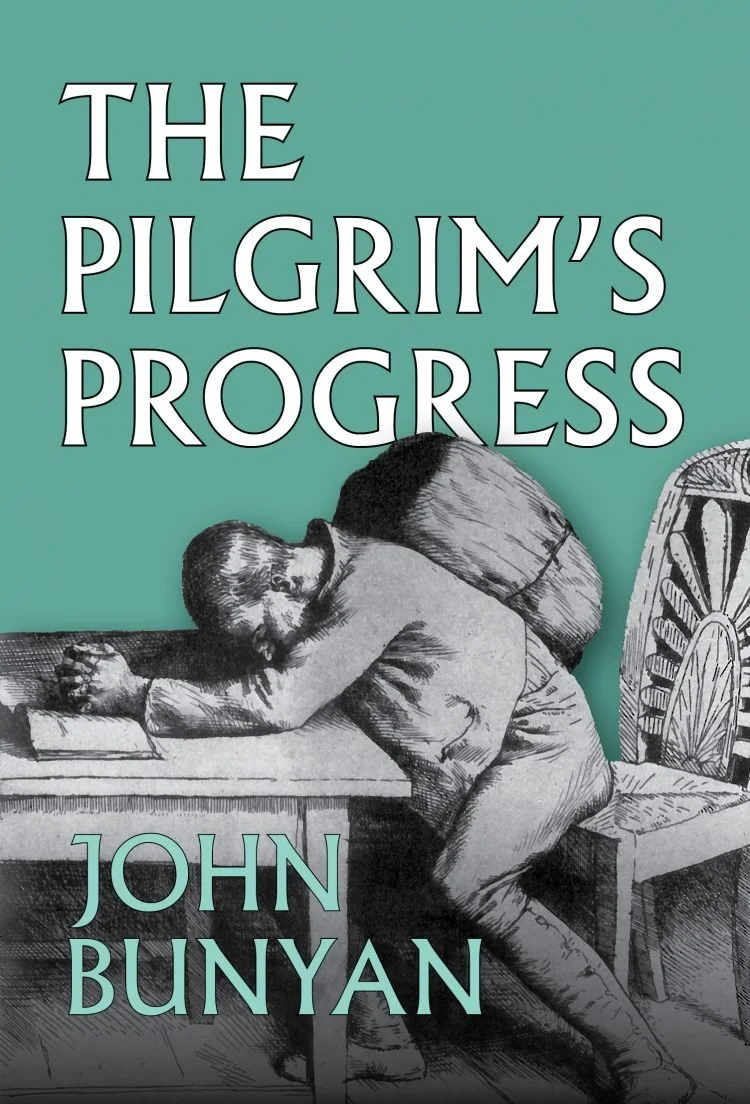
Notes on *The Pilgrim’s Progress*
The Pilgrim’s Progress, John Bunyan, 1678, (Banner of Truth)
Note-taker’s Preface: John Bunyan’s classic, The Pilgrim’s Progress, is a book unlike any other. Originally published in 1678, it has sold more than any other book in the English language at around 250 million copies. It’s popularity is due to its profundity. The relevance of Bunyan’s allegory for Christian discipleship, even so many years removed from when he wrote, is simply stunning. I hope that these notes can be a quick-reference guide to some key parts of the story, and that you can consult these notes for illustration helps. My personal goal is to eventually be so acquainted with the novel that I can use Christian”s journey as a field guide for my own, and for those I shepherd.
Lastly, my favorite edition of the book is a recent release from Banner of Truth. It is an elegant, 7x5 hardcover with the original etchings by William Strang.
Interaction
"The two children: Patience and Passion" (28)
"The fire burns hotter and brighter" (30)
"At the Palace Beautiful = the local church" (46)
"The effect of Christian fellowship." (58)
"How the church's fellowship builds us up" (58)
"Would that this be enough for my rest!" (62)
"Faithful is murdered by the jury in Vanity Fair." (110)
"After the death of Faithful, Hopeful steps up to befriend Christian." (112)
"Christian and Hopeful mutually encourage one another, each for the other at different times." (158)
"What a sinner's prayer!" (164)
Characters
Part I
Christian
Husband and father stricken by spiritual crisis. Christian is told by a messenger to leave his doomed city and begin a journey of progress toward spiritual achievement.
Evangelist
The messenger carrying the Gospel, or word of Christ, to Christian. Evangelist spurs Christian on his journey to the Celestial City.
Obstinate
A neighbor of Christian’s in the City of Destruction who refuses to accompany him.
Pliable
A neighbor of Christian’s who accompanies him for a while. After falling in the Slough of Despond, Pliable is discouraged and returns home, only to be mocked by the townsfolk.
Help
Fellow pilgrim who helps pull Christian from the Slough of Despond.
Worldly Wiseman
A reasonable and practical man whom Christian encounters early in his journey. Worldly Wiseman tries unsuccessfully to urge Christian to give up his religious foolishness and live a contented secular life.
Formalist
A traveler whom Christian meets along the wall of Salvation. With his companion Hypocrisy, Formalist sneaks over the wall, instead of following the strait and narrow as Christian did.
Hypocrisy
Formalist’s travel companion.
Discretion
One of the four mistresses of the Palace Beautiful. Discretion takes Christian in and feeds him.
Piety
One of the four mistresses of the Palace Beautiful. Piety asks Christian about his journey so far.
Prudence
One of the four mistresses of the Palace Beautiful. Prudence tries to understand Christian’s purpose in traveling to Mount Zion.
Charity
One of the four mistresses of the Palace Beautiful. Charity asks Christian why he did not bring his family, which causes him to weep.
The Interpreter
Spiritual guide who shelters Christian. The Interpreter instructs Christian in the art of reading religious meanings hidden in everyday objects and events, which he houses in his Significant Rooms.
Apollyon
Fierce monster with fish scales, bear feet, and dragon wings. Apollyon threatens Christian and fights him with sword until Christian defeats him.
Shining Ones
Three celestial creatures who clothe Christian with new garments and give him the certificate. The Shining Ones act as guardians throughout Christian’s journey.
Faithful
Fellow pilgrim from Christian’s hometown who reports on the city they both left behind. Faithful loyally accompanies Christian until he is executed in the town of Vanity for the crime of disrespecting the local Satan-worshipping religion.
Talkative
Fellow pilgrim who travels alongside Christian and Faithful for a while. Talkative is spurned by Christian for valuing spiritual words over religious deeds.
Mr. By-ends
A user of religion for personal ends and social profit. Mr. By-ends accompanies Christian briefly after Christian escapes from Vanity.
Hopeful
Pilgrim who replaces Faithful as Christian’s travel companion and confidant after leaving Vanity, all the way to the Celestial City. Hopeful saves Christian’s life in the river before the gates to Mount Zion.
Giant Despair
Master of the Doubting Castle. Giant Despair imprisons Hopeful and Christian for trespassing on his domain and is later killed by Great-heart and Christiana’s sons.
Diffidence
Giant Despair’s wife. She encourages the harsh punishment of Hopeful and Christian in the Doubting Castle.
Demas
Gentlemanly figure who tries to entice Christian and Hopeful with silver and dreams of wealth.
Temporary
A would-be pilgrim whom Christian speaks of in a cautionary way, warning of Temporary’s backsliding before his spiritual progress was complete.
Part II
Sagacity
An elderly man who visits the narrator in his dream. After the narrator asks after Christian’s family, Sagacity offers to take the narrator’s place as the storyteller and recount Christiana’s journey.
Christiana
Christian’s wife and the titular pilgrim in Part II. As a spiritual voyager and a guide to her children, Christiana shows remarkable strength and resilience on the journey.
Mercy
Christiana’s neighbor employed by her as a servant on her pilgrimage. She later marries Matthew, Christiana’s eldest son.
Matthew
Christiana’s eldest son, who eventually marries Mercy. After stealing fruit from the devil’s garden, Matthew must be healed by Dr. Skill.
Joseph
A son of Christiana.
Samuel
A son of Christiana.
James
Christiana’s youngest son.
Ill-Favored Ones
Two strangers who attempt to harm Christiana and Mercy.
Reliever
Fellow pilgrim who rescues Christiana and Mercy from the two Ill-Favored Ones.
Mr. Great-heart
The Interpreter’s manservant. He protects and guides Christiana and Mercy on their way up the hill of Difficulty and toward the House Beautiful.
Watchful
Porter of the House Beautiful.
Grim
Master of the lions, who threatens Christiana and Mercy on their way to the House Beautiful.
Maul
A giant killed by Great-heart. He accuses Great-heart of kidnapping the pilgrims.
Mr. Brisk
Mercy’s suitor. He ends their affair because she is too involved in charity work.
Old Honest
An elderly pilgrim. While accompanying Christiana and her group, he relates the sad demise of the pilgrim Fearing.
Mr. Fearing
A pilgrim who accompanies Honest for some time. Mr. Fearing is courageous in the face of physical danger but insufficiently certain about his desire to reach the Celestial City.
Gaius
A homeowner and host who welcomes Christiana and her group. Two of Gaius’s daughters marry two of Christiana’s sons.
Giant Good-Slay
A giant slain by Gaius, Great-heart, and others. He almost devours the pilgrim Feeble-mind.
Heedless
A pilgrim who falls asleep near the end of his pilgrimage and talks in his sleep, showing his basic failure to understand pilgrimage.
Too-bold
Heedless’s cohort.
Madam Bubble
A tall, attractive, dark-skinned temptress. Madam Bubble offers Standfast herself and her money if he will stay with her.
Standfast
The last pilgrim met by Christiana. Standfast is found kneeling on the ground and praying in thanks for having been delivered from the temptation of Madam Bubble.
Mr. Feeble-Mind
A mentally slow pilgrim captured and nearly killed by the giant Good-Slay. Mr. Feeble-Mind is rescued by Gaius and joins Christiana’s group of pilgrims.
Mr. Ready-to-Halt
A handicapped pilgrim who joins Christiana’s group on crutches.
Mr. Mnason
Pilgrim with whom Christiana’s group lodges. Two of Mnason’s daughters are married off to Christiana’s sons.
Contrite
Friend of Mnason’s, who says that the locals feel a burden of guilt after the unjust execution of Christian’s friend Faithful.
Valiant-for-truth
A strong, sword-wielding pilgrim. Valiant-for-truth drives off three attackers single-handedly and joins Christiana’s group at the end of their journey.
Favorite Quotes by Chapter
The Author's Apology for His Book
"Which way it pleases God: For who knows how, Better than he that taught us first to Plough, To guide our Mind and Pens for his Design? And he makes base things usher in Divine." (xiii)
Part I: The Pilgrim's Progress: in the similitude of a dream
"I dreamed, and behold I saw a Man clothed with rags, standing in a certain place, with his face from his own house, a Book in his hand, and a great Burden upon his back." (1)
"So I saw in my dream that the Man began to run; Now he had not run far from his own door, but his Wife and Children perceiving it, began to cry after him to return; but the Man put his fingers in his ears, and ran on crying, Life! Life! Eternal Life! So he looked not behind him, but fled towards the middle of the Plain." (5)
"World. Wilt thou hearken to me if I give thee counsel? Chr. If it be good, I will; for I stand in need of good counsel." (13)
"Chr. Why, Sir, this Burden upon my back is more terrible to me, than are all these things which you have mentioned" (14)
"The man that met thee, is one Worldly-Wiseman, and rightly is he so called; partly, because he savoureth only the doctrine of this world; (therefore he always goes to the town of Morality to church) and partly, because he loveth that doctrine best; for it saveth him from the Cross; and because he is of this carnal temper, therefore he seeketh to pervert my ways, though right." (18)
"So he had him into a private room, and bid his man open a door; the which when he had done, Christian saw the picture of a very grave Person hang up against the wall; and this was the fashion of it, It had eyes lifted up to Heaven, the best of Books in his hand, the Law of Truth was written upon his lips, the World was behind his back; it stood as if it pleaded with men, and a Crown of Gold did hang over its head." (26)
"The man whose picture this is, is one of a thousand; he can beget children, travel in birth with children, and nurse them himself when they are born. And whereas thou seest him with eyes lift up to Heaven, the best of Books in his hand, and the Law of Truth writ on his lips; it is to shew thee, that his work is to know and unfold dark things to Sinners; even as also thou seest him stand as if he pleaded with men; and whereas thou seest the World as cast behind him, and that a Crown hangs over his head; that is to shew thee, that slighting and despising the things that are present, for the love that he hath to his Master's service, he is sure in the World that comes next, to have Glory for his reward." (26-27)
"Chr. Then said Christian, Now I see that Patience has the best Wisdom, and that upon many accounts. 1. Because he stays for the best things. 2. And also because he will have the Glory of his, when the other has nothing but rags." (29)
"The Interpreter answered, This is Christ, who continually with the Oil of his Grace maintains the work already begun in the heart: By the means of which, notwithstanding what the Devil can do, the souls of his people prove gracious still. And in that thou sawest, that the Man stood behind the wall to maintain the Fire; this is to teach thee, That it is hard for the Tempted to see how this Work of Grace is maintained in the soul." (30-31)
"Then was Christian glad and lightsome, and said with releases us of our Guilt and a merry heart, He hath given me Rest by his Sorrow, and Burden, we Life by his Death. Then he stood still a while to look and wonder; for it was very surprising to him, that the sight of the Cross should thus ease him of his Burden. He looked therefore, and looked again, even till the springs that were in his head sent the waters down his cheeks." (38)
"Chr. I walk by the Rule of my Master, you walk by the rude working of your fancies." (40)
"Sometimes he sighed, sometimes he wept, and oftentimes he chid himself for being so foolish to fall asleep in that place which was erected only for a little refreshment from his weariness." (45)
"Fear not the Lions, for they are chain'd, and are placed there for Trial of Faith, where it is, and for Discovery of those that have none: Keep in the midst of the Path, and no hurt shall come unto thee." (47)
"Piety. But did you not come by the House of the Interpreter? Chr. Yes, and did see such things there, the remembrance of which will stick by me as long as I live: Especially three things, to wit, How Christ, in despite of Satan, maintains his Work of Grace in the heart; how the Man had sinned himself quite out of hopes of God's Mercy; and also the dream of him that thought in his sleep the Day of Judgment was come." (50)
"Prud. Can you remember by what Means you find your annoyances at times, as if they were vanquished? Chr. Yes, when I think what I saw at the Cross, that will do it; and when I look upon my 'broidered Coat, that will do it; also when I look into the Roll that I carry in my bosom, that will do it; and when my thoughts wax warm about whither I am going, that will do it." (52)
"The name of the chamber was Peace, where he slept till break of Day, and then he awoke and sang,
Where am I now! Is this the Love and Care
Of Jesus; for the men that Pilgrims are,
Thus to provide! That I should be forgiven,
And divel already the next door to Heaven!" (56)
"Whilst Christian is among his godly friends, Their golden mouths make him sufficient 'mends For all his griefs; and when they let him go, He's clad with northern steel from top to toe." (58)
"Chr. All this is true, and much more, which thou hast left out; but the Prince whom I serve and honour, is merciful and ready to forgive: But besides, these Infirmities possessed me in thy Country; for there I sucked them in, and I have groaned under them, been sorry for them, and have obtained Pardon of my Prince." (62)
"And I thought again, this Shame tells me what men are; but it tells me nothing what God or the Word of God is. And I thought moreover, That at the Day of Doom we shall not be doomed to Death or Life, according to the hectoring spirits of the world, but according to the Wisdom and Law of the Highest. Therefore, thought I, what God says, is best, though all the men in the world are against it: Seeing then that God prefers his Religion; seeing God prefers a tender Conscience; seeing they that make themselves fools for the Kingdom of Heaven, are wisest; and that the poor man that loveth Christ, is richer than the greatest man in the world that hates him; Shame, depart, thou art an Enemy to my Salvation; shall I entertain thee against my Sovereign Lord? How then shall I look him in the Face at his Coming? Should I now be ashamed of his Ways and Servants, how can I expect the blessing?"(82)
"Faith. Oh! a great deal: A man may cry out against Sin, of Policy, but he cannot abhor it but by virtue of a godly antipathy against it. I have heard many cry out against Sin in the Pulpit, who yet can abide it well enough in the Heart, House, and Conversation." (91)
"They therefore brought him out, to do with him according to their Law; and first they scourged him, then they buffeted him, then they lanced his flesh with knives: after that they stoned him with stones, then pricked him with their swords; and last of all, they burnt him to ashes at the Stake. Thus came Faithful to his end." (110)
"Now I saw in my dream, that Christian went not forth alone; for there was one whose name was Hopeful, (being made so by the beholding of Christian and Faithful in their words and behaviour, in their sufferings at the Fair) who joined himself unto him, and entering into a brotherly covenant, told him, that he would be his companion. Thus one died to make testimony to the Truth, and another rises out of his ashes to be a companion with Christian in his Pilgrimage." (112)
"Hope. My Brother, said he, remembrest thou not, how valiant thou hast been heretofore?" (135)
"Hopeful comforts him again by calling former things to remembrance." (135)
"Now, a little before it was Day, good Christian, as one half amazed, brake out in this passionate speech; What a Fool, quoth he, am I, thus to lie in a stinking dungeon, when I may as well walk at liberty? I have a key in my bosom, called Promise, that will I am persuaded open any lock in Doubting-Castle. Then said Hopeful, That's good news, good brother, pluck it out of thy bosom and try." (136-137)
"Let us lie down here, and take one nap. Chr. By no means, (said the other) lest sleeping we never awake more." (158)
"Hope. Another thing that hath troubled me even since my late amendments is, that if I look narrowly into the best of what I do now, I still see Sin, new Sin, mixing itself with the best of that I do; so that now I am forced to conclude, that notwithstanding my former fond Conceits of myself and duties, I have committed Sin enough in one duty to send me to Hell, tho' my former life had been faultless." (162)
"God be merciful to me a Sinner, and make me to know and believe in Jesus Christ; for I see, that if his Righteousness had not been, or I have not Faith in that Righteousness, I am utterly cast away. Lord, I have heard that thou art a merciful God, and hast ordained that thy Son Jesus Christ should be the Saviour of the World; and moreover, that thou art willing to bestow upon such a poor sinner as I am, (and I am a sinner indeed) Lord, take therefore this opportunity, and magnify thy Grace in the Salvation of my soul, through thy Son Jesus Christ. Amen." (164)
"Now I further saw, that betwixt them and the Gate was a River, but there was no bridge to go over, and the river was very deep."(181)
"They then addressed themselves to the Water, and entering, Christian began to sink, and crying out to his good friend Hopeful, he said, I sink in deep Waters; the Billows go over my head, all the Waves go over me. Selah. Then said the other, Be of good cheer, my Brother, I feel the bottom, and it is good." (182)
"Then I saw in my dream, That Christian was as in a muse a while. To whom also Hopeful added these words, Be of good cheer, Jesus Christ maketh thee whole: And with that Christian brake out with a loud voice, Oh, I see him again! and he tells me, When thou passest through the Waters, I will be with thee; and through the Rivers, they shall not overflow thee. Then they both took courage, and the Enemy was after that as still as a stone, until they were gone over." (184)
"Now, just as the Gates were opened to let in the men, I looked in after them; and behold the City shone like the Sun, the streets also were paved with Gold, and in them walked many men with Crowns on their heads, Palms in their hands, and Golden Harps to sing praises withal." (188)
Part II: The Pilgrim's Progress: from this world to that which is to come
"Then said the Visiter, Christiana! the Bitter is before the Sweet. Thou must through Troubles, as did he that went before thee, enter this Celestial City." (210)
"The Bitter must come before the Sweet, and that also will make the Sweet the sweeter."
"Rel. It is not always necessary to grant things not asked for, lest by so doing, they become of little esteem; but when the Want of a thing is felt, it then comes under, in the eyes of him that feels it, that estimate, that properly is its due, and so consequently will be hereafter used." (230)
"the Interpreter takes them apart again, and has them first into a room, where was a Man that could look no way but downwards, with a muckrake in his hand: There stood also one over his head, with a Celestial Crown in his hand, and proffered to give him that Crown for his muckrake; but the man did neither look up, nor regard, but raked to himself the straws, the small sticks, and dust of the floor."(234)
"Give me not Riches, is scarce the prayer of one of ten thousand. Straws and sticks, and dust, with most, are the great things now looked after." (236)
"It was fine Linen white and clean. When the women were thus adorned, they seemed to be a terror one to the other; for that they could not see that Glory each one on herself, which they could see in each other. Now therefore they began to esteem each other better than themselves. For you are fairer than I am, said one; and you are more comely than I am, said another."
"Pilgrims should watch, and remember what they have already received under their greatest enjoyments; but for want of doing so, ofttimes their rejoicing ends in tears, and their sun-shine in a Cloud." (258)
"Jos. That Sin is so great and mighty a Tyrant, that none can pull us out of its clutches, but God; and that God is so good and loving to Man, as to pull him indeed out of this miserable state. Prud. What is God's design in saving of poor men? Jos. The glorifying of his Name, of his Grace, and Justice, and the everlasting Happiness of his Creature." (268)
"Pray how fareth it with you in your Pilgrimage? (331)
"Hon. It happens to us, as it happeneth to wayfaring men; sometimes our Way is clean, sometimes foul; sometimes up hill, sometimes down hill; we are seldom at a certainty: The wind is not always on our backs, nor is every one a Friend that we meet with in the Way. We have met with some notable rubs already; and what are yet behind we know not; but for the most part we find it true, that has been talked of of old: A good man must suffer trouble."(331)
"My marks and scars I carry with me, to be a witness for me, that I have fought His battles, who now will be my Rewarder." (373)
"The waters indeed are to the palate bitter, and to the stomach cold; yet the thoughts of what I am going to, and of the conduct that waits for me on the other side, doth lie as a glowing coal at my heart." (375)
"I heard one say, that they were yet alive, and so would be for the increase of the Church in that place where they were, for a time." (376)
Notable Content
Four Reasons for Backsliding (176-178)
Notes on *Possessed by God*
Possessed by God: A New Testament Theology of Sanctification and Holiness, David Peterson (IVP, 1995)
Main Idea/Takeaway
Moral holiness in the Christian life, typically called "progressive sanctification" is better understood and practiced in the biblical terms of renewal, transformation, and growth — expressions of our definitive sanctification.
"I will argue that definitive sanctification is a more important theme in the New Testament than has generally been acknowledged. Rightly understood, this doctrine is a key to holy living and a way through the impasse created by much previous debate. God calls us and enables us in Christ to live as those possessed by God and empowered by his Holy Spirit. This is the theme of the first three chapters of this book. The fourth chapter then examines New Testament exhortations to pursue holiness and considers the sense in which sanctification is a process of 'becoming' and 'acting'."(14)
"The overall aim will be to hear afresh God's challenge to holiness, encouraged by the promises on which it is grounded and guided by the teaching with which it is associated." (16)
"Sanctification is commonly regarded as a process of moral and 'spiritual transformation following conversion. In the New Testament, however, it primarily refers to God's way of taking possession of us in Christ, setting us apart to belong to him and to fulfil his purpose for us. Sanctification certainly has present and ongoing effects, but when the verb 'to sanctify' (Gk. hagiazein) and the noun 'sanctification' (Gk. hagiasmos) are used, the emphasis is regularly on the saving work of God in Christ, applied to believers through the ministry of the Holy Spirit." (27)
"It would be more accurate to say that renewal and change flow from the regeneration and sanctification that God has already accomplished in our lives." (136)
"Instead of speaking in terms of progressive sanctification, the New Testament more regularly employs the language of renewal, transformation and growth, to describe what God is doing with us here and now." (136)
"In New Testament terms, we are to live as those who have been brought from death to life, discharged from the law to belong to Christ, led by the Spirit in a continuing struggle with the flesh. We are to live with a confidence in what God has already done for us and trust in him to continue his transforming work in us until we see him face to face." (137)
Interaction
The holiness of God, cf. Webster. (16)
"But they are unable to effect such living" (21)
On mission: "Mission is clearly the goal of sanctification in John17." (30)
"Are you living by your assessment of your life or God's?" (49)
"Believe the gospel. Embrace your identity in Christ. Live by God's assessment of your life." (49)
"Think in terms not of measurable maturity, but trajectories of current devotion & practice. The "Pilgrim's Progress" allegory is again masterful." (91)
cf. Beale article: relation between new creation and reconciliation in 2 Corinthians. (133)
Present experience of glorification. (133)
Table of Contents
Introduction
I. The biblical starting-point
II. Sanctified in Christ
III. Sanctified by word and Spirit
IV. Pursuing holiness
V. Living between the cross and the resurrection
VI. Transformation, renewal, and growth
Appendix A: The meaning of hagiasmos in the New Testament
Appendix B: Sanctification and God's law
Favorite Quotes by Chapter
Introduction
"Considering the passion for holiness expressed by writers and preachers in former generations, James Packer may be right to claim that 'holiness is a neglected priority throughout the modern church generally' and 'specifically a fading glory in today's evangelical world' (1984: 99)." (11)
"Despite the significant work of Packer and others, there is room for a fresh look at the subject, with a particular focus on what the New Testament teaches about the way holiness is achieved and expressed."(12)
"The assumption is generally made that sanctification is simply the process by which we become more and more holy." (13)
"It obscures the distinctive meaning and value of the terminology in the New Testament, confusing sanctification with renewal and transformation." (13)
"Sanctification is a state in which believers find themselves because of the work of Christ and the operation find themselves because of the work of Christ and the operation of his Spirit in their lives. They are called to remain in that state 'by living in correspondence to their given holiness' (614)." (14)
"In sum, sanctification in the New Testament is seen as 'a one-time event and as a process, the believers being and becoming holy and acting correspondingly' (614)." (14)
I. The biblical starting- point
"Even though the holiness of God cannot be adequately conveyed in vision or word, angelic beings declared that it could be encountered in our universe, which is like a vast temple dedicated to his use and the display of his glory. God's glory is his holiness revealed."(18)
"The covenant relationship established by God contained at its heart the assurance that he would be their God and they would be his people (e.g. n. 17:7-8; Ex. 6:7). Consequently, he would be uniquely with them, to fulfil his purposes and bring blessing to them (e.g. Gn. 28:13-15; Ex. 3:7-8)." God's sanctifying presence would continue to mark them as a holy people and demand holiness of living as a response." (21)
"Holiness cannot simply be acquired by human effort. It is a status or condition which God imparts to those whom he chooses to bring into a special relationship with himself through covenant and redemption. But it is a status that carries with it particular responsibilities."(23)
"Just as Israel was made holy by God's saving activity in the time of Moses, and again in the restoration after the Babylonian Exile, so sanctification in the New Testament is an integral part of the redemptive work of Jesus Christ. It is regularly portrayed as a once-for-all, definitive act and primarily has to do with the holy status or position of those who are 'in Christ'." (24)
"Christians are sustained in holiness by the ongoing presence of the Holy Spirit and the trust that he gives in the finished work of Christ. The essential work of the Spirit is to enable belief in the gospel, so that the blessings it offers may be continually enjoyed by God's people." (24)
"Christians are called to live out the practical consequences of knowing God in Jesus Christ and of being consecrated by his saving work. Everything that is said about moral change and personal transformation in the New Testament is to be related to God's sanctifying initiative in Christ." (25)
"...sanctification in Christ has to do with a profound re-orientation of values and behavior. Beginning with the 'heart' and reaching out to touch the life and witness of God's people at every level, God's word and God's Spirit bring change and transformation. In us and through us, something of God's holiness is revealed to the world." (25)
II. Sanctified in Christ
"At the heart of the revelation that Jesus brings is the proclamation of God's redemptive achievement in the death of his Son. In his death, Jesus demonstrates the love which God has for the world and which he desires to see reflected in the life of his people. With the gospel message about Jesus and his work, God imparts his Spirit to us and binds us to himself in love. That same word keeps us in holiness and love, enabling us to share in his mission to the world." (33)
"By his sovereign action in Christ, God sets apart and binds to himself those who have been purified from the defilement of sin. This objective, consecrating work of God has profound implications for the attitude and behavior of those who believe." (34)
"Although Israel under the Old Covenant was able to draw near to God through the mediation of priests and the operation of the sacrificial system, the people were not 'perfected' in their approach to God (gf. 7:11; 10:1-2). However, with Jesus, 'a better hope' has been introduced by which we may draw near to him (7:19; 10:14)." (36)
"This better hope is based on the 'better covenant', which has been enacted through 'better promises' (8:6). Here and now, we are 'qualified' to draw near to God with the certainty of sins forgiven and the confidence that we are in an eternally secure relationship with God (c/. 7:19; 9:9; 10:1-4, 14-23; 12:22-24). Our hope is also to meet God face-to-face, in the glory of his eternal kingdom (c/. 2:10; 4:9-10; 12:14, 22-24; 13:14), and so perfection in Hebrews involves ultimate glorification. Even so, what we have yet to experience is only an unfolding of what has already been achieved for us by Christ's sacrifice." (36)
"The terminology of perfection is used to proclaim the fulfilment or consummation of men and women in a permanent, direct and personal relationship with God."(36)
"Jesus' death brings about a cleansing from sin and a definitive consecration to God in the present. It also secures for us a share in the future that God has promised. We can draw near to God now with the directness and certainty that belong to the final state of his people (cf. 4:16; 10:19-22: 12:22-24). The perfecting of believers involves all of that. Our sanctification or consecration to God is only a part of the process of eschatological perfection, achieved through the perfecting of Christ (2:10; 5:9; 7:28)." (37)
"The New Covenant promise of a renewed 'heart' is fulfilled when people are set free from the burden of unforgiven sins through trusting in the effectiveness of Christ's sacrifice (9:14; 10:22). They are thus renewed in faith and sincerity towards God. Only the cleansing provided by Christ can definitively free us to worship or serve the living God (9:14, Gk. latreuein) in a way that pleases him and truly honors him." (39)
"Sanctification means being appropriated by God and dedicated to him by the saving work of his Son. The terminology is associated with the beginning of the Christian life and highlights the corporate dimension to sanctification in Paul's thinking. Sanctification has to do with the identity and status of those who are 'in Christ'. It also points to the lifestyle that is consistent with God's calling." (40)
"The next clause, 'to those sanctified in Christ' (Ck. hegiasmenois en Christo), amplifies what it means to be God's church. The Corinthian Christians were a holy and distinct people in that corrupt and godless city. This was so because of God's initiative, drawing them into an exclusive relationship with himself.? What he had done for them "in Christ Jesus' had made them part of his eschatological community. Here the perfect passive participle "sanctified' should be understood as another way of speaking about their conversion and incorporation into Christ. It can hardly refer to their holiness of character or conduct, since Paul spends much time in this letter challenging their values and their behavior, calling them to holiness in an ethical sense. He does this on the basis that they are already sanctified in a relational sense, but need to express that sanctification in lifestyle." (41)
"Jesus delivers us from the dominion of sin and death (redemption). By his righteousness he also makes it possible for us to be counted righteous by God (justification). At the same time, he establishes us in a distinct and exclusive relationship with the Holy One (sanctification). In the great Christological statement of 1 Corinthians 1:30, redemption, justification and sanctification are overlapping, but distinct theological concepts. This judgment is confirmed by the argument in 1 Corinthians 6:11." (44)
"The Spirit's work is to empower the preaching of the gospel about Jesus, enabling those who hear to understand and believe (2:4-5; cf. 2:6-16). So the Spirit is the means whereby God in the present age 'effects the work of Christ in the believer's life' (Fee 1994: 219)." (47)
"Sanctification is about being possessed by God and expressing that distinctive and exclusive relationship by the way we live." (48)
III. Sanctified by word and Spirit
"Here it is important to note that everything in the Christian life, from beginning to end, is made possible by Jesus' self-giving in death (Eph. 5:25), previously described as 'a fragrant offering and sacrifice to God' (5:2). Only those who are sanctified by Christ now can be presented to him in glory then. Transformation is implied by the notion of glorification (cf. Rom. 8:29-30; 2 Cor. 3:18; 1 Jn. 3:2), the present work of the Spirit anticipating the ultimate transformation associated with the resurrection of our bodies." (54)
"By faith in the gospel, we continue to be united with Christ, which is the heart of sanctification. By faith, we rely on his promises and grasp the power of his Spirit, so that we can resist sin and live for God. This theme will be particularly developed in chapter five. Faith is 'not only a receptive organ but also an operative power." (56)
"When God sanctifies us as individuals, he establishes us as members of a holy fellowship, enabling us to play our part in maintaining and expressing the holiness of the church, in doctrine and lifestyle." (67)
IV. Pursuing holiness
"So the challenge is to pursue practical expressions of the holiness or sanctification that is ours in Christ." (75)
"Those who are cleansed and consecrated by Christ, and who look forward to sharing the perfection of holiness in his presence for ever, will pursue holiness as a lifestyle." (77)
"Indeed, the Spirit he gives to Christians is the Spirit of holiness; and nothing unholy can be tolerated in the lives of individuals or communities where the Holy Spirit dwells (gf. 1 Cor. 3:16-17; 6:19-20; 2 Cor. 6:14-7:1)." (84)
"The promises about God dwelling in the midst of his people, and welcoming as his sons and daughters those who separate themselves from everything unclean (6:16-18), are the motivation for a holy and separated life." (87)
"From a positive point of view, the secret of a holy life is reflecting the character of God, knowing that his Spirit is at work amongst his people to make that separate and distinct lifestyle possible, and thus walking in the Spirit's ways. When they ignore these imperatives, believers dishonor the one who called them into an exclusive relationship with himself and compromise the holiness of the church as 'the temple of the living God' (6:16; cf. 1 Cor. 3:16-17; Heb. 12:15)." (88)
"No Christian should doubt the need to give practical, everyday expression to the holiness that is our status and calling in Christ. Only those who trust in his sanctifying work on the cross, and take seriously the warning to 'pursue holiness', will 'see the Lord'." (91)
"On the other hand, it is possible to be so zealous for 'progress' that one's attention shifts from God's grace to human effort. Moral growth and development will be God's gift to us at different stages of our lives, but spirituality must not be measured in terms of the rate of change. We are to go on exhibiting what we know of God's character and will, motivated by the certainty of his acceptance, cleansing and enabling in Christ, together with the promise of entire sanctification when we meet him, face to face. Progress may be seen as we exercise ourselves in that godly devotion which issues from a true knowledge of God in Jesus Christ." (91)
V. Living between the cross and the resurrection
"When he moves to consider how justification by faith can lead to holiness of life, Calvin emphasizes the role of repentance. Repentance not only follows faith but is born of faith. Repentance means the true turning of our life to God, a turning that arises from a pure and honest fear of him' (Inst. 3.3.5). It consists in 'mortification of our flesh and of the old man' and in 'vivification of the Spirit'." (93)
"In this chapter, I want to explore the idea that moral renewal proceeds from our union with Christ in his death and resurrection." (95)
"Baptism into union with Christ is the way we identify with him in his epoch-changing death and draw on its benefits. Of course, conversion and water baptism are often separated in Christian experience. But Paul's point is that genuine initiation into Christ means trusting in his death as our death and his risen life as our life. In this respect, baptism is presented as our 'funeral rite' and a decisive break with the life and values of this present age." (97)
VI. Transformation, renewal, and growth
"What makes me a new person in Christ is essentially faith in God and his promises. The Spirit's ongoing task is to renew my "mind' through the gospel and give me a new 'heart' to serve God in faith and obedience. Renewal of mind and heart transforms character and behavior because of the central place that the mind has in the orientation, attitudes and beliefs of the human personality. Renewal is not simply at the rational level, though this is foundational to the whole process of moral renewal and change that is effected by the Spirit. In the final analysis, renewal is the present experience of glorification through the Spirit, anticipating the glorification that will come with the resurrection of our bodies. It is being conformed to the likeness of Christ, who is himself the image of God."(133)
"If we are definitively sanctified by the work of Christ and the gift of his Spirit, 'growth' in holiness will mean increasing and abounding in practical expressions of that status calling and commitment which is already ours by God's grace." (136)
Notable Content
Definitive Sanctification explained. (14)
"To what extent are we urged by Scripture to progress in holiness and in what manner? How should we pray for one another in this regard? How might we expect God to answer our prayers?" (71)
Understanding Hebrews chapter 12. (75)
Four senses in which Christians die to sin. (97)
Brief comments on the concept of growth in the New Testament. (134)