

Notes on *Redemption Accomplished and Applied*
Redemption Accomplished and Applied, John Murray, (Eerdmans, 1955)
Main Idea/Takeaway
The atonement, central to the Christian faith, has its source in the free and sovereign love of God.
Interaction
"Lamb and Priest" (28)
"Faith is not a work" (85)
"On mystery" (167)
"On union" (168)
Table of Contents
Part I: Redemption Accomplished
I. The Necessity of the Atonement
II. The Nature of the Atonement
III. The Perfection of the Atonement
IV. The Extent of the Atonement
V. Conclusion
Part II: Redemption Applied
I. The Order of Application
II. Effectual Calling
III. Regeneration
IV. Faith and Repentance
V. Justification
VI. Adoption
VII. Sanctification
VIII. Perseverance
IX. Union with Christ
X. Glorification
Favorite Quotes by Chapter
Part I: Redemption Accomplished
I. THE NECESSITY OF THE ATONEMENT
“No treatment of the atonement can be properly oriented that does not trace its source to the free and sovereign love of God.” (9)
“God was pleased to set his invincible and everlasting love upon a countless multitude and it is the determinate purpose of this love that the atonement secures.” (10)
“The reason resides wholly in himself and proceeds from determinations that are peculiarly his as the "I am that I am." The atonement does not win or constrain the love of God. The love of God constrains to the atonement as the means of accomplishing love's determinate purpose.” (10)
“In a word, while it was not inherently necessary for God to save, yet, since salvation had been purposed, it was necessary to secure this salvation through a satisfaction that could be rendered only through substitutionary sacrifice and blood-bought redemption.” (12)
“The more we emphasize the inflexible demands of justice and holiness the more marvelous become the love of God and its provisions.” (18)
II. THE NATURE OF THE ATONEMENT
“The real use and purpose of the formula is to emphasize the two distinct aspects of our Lord's vicarious obedience. The truth expressed rests upon the recognition that the law of God has both penal sanctions and positive demands. It demands not only the full discharge of its precepts but also the infliction of penalty for all infractions and shortcomings. It is this twofold demand of the law of God which is taken into account when we speak of the active and passive obedience of Christ. Christ as the vicar of his people came under the curse and condemnation due to sin and he also fulfilled the law of God in all its positive requirements.” (21)
“We must interpret the sacrifice of Christ in terms of the Levitical patterns because they were themselves patterned after Christ's offering.” (27)
“That Christ's work was to offer himself a sacrifice for sin implies, however, a complementary truth too frequently over-looked. It is that, if Christ offered himself as a sacrifice, he was also a priest. And it was as a priest that he offered himself. He was not offered up by another; he offered himself.” (28)
“The propitiation of the divine wrath, effected in the expiatory work of Christ, is the provision of God's eternal and unchangeable love, so that through the propitiation of his own wrath that love may realize its purpose in a way that is consonant with and to the glory of the dictates of his holiness.” (31)
“Thirdly, propitiation does not detract from the love and mercy of God; it rather enhances the marvel of his love. For it shows the cost that redemptive love entails. God is love. But the supreme object of that love is himself. And because he loves himself supremely he cannot suffer what belongs to the integrity of his character and glory to be compromised or curtailed. That is the reason for the propitiation. God appeases his own holy wrath in the cross of Christ in order that the purpose of his love to lost men may be accomplished in accordance with and to the vindication of all the perfections that constitute his glory.” (32)
“The wrath of God is the inevitable reaction of the divine holiness against sin. Sin is the contradiction of the perfection of God and he cannot but recoil against that which is the contradiction of himself. Such recoil is his holy indignation.” (32)
“To deny propitiation is to undermine the nature of the atonement as the vicarious endurance of the penalty of sin. In a word, it is to deny substitutionary atonement. To glory in the cross is to glory in Christ as the propitiatory sacrifice once offered, as the abiding propitiatory, and as the one who embodies in himself for ever all the propitiatory efficacy of the propitiation once for all accomplished.” (32)
“Reconciliation presupposes disrupted relations between God and men. It implies enmity and alienation. This alienation is twofold, our alienation from God and God's alienation from us. The cause of the alienation is, of course, our sin, but the alienation consists not only in our unholy enmity against God but also in God's holy alienation from us.” (33)
“Redemption from the power of sin may be called the triumphal aspect of redemption. In his finished work Christ did something once for all respecting the power of sin and it is in virtue of this victory which he secured that the power of sin is broken in all those who are united to him. It is in this connection that a strand of New Testament teaching needs to be appreciated but which is frequently overlooked. It is that not only is Christ regarded as having died for the believer but the believer is represented as having died in Christ and as having been raised up with him to newness of life? This is the result of union with Christ. For by this union Christ is not only united to those who have been given to him but they are united with him. Hence not only did Christ die for them but they died in him and rose with him (cf. Rom. 6:1-10; 2 Cor. 5:14, 15; Eph. 2:1-7; Col. 3:1-4; I Pet. 4:1, 2).” (48)
III. THE PERFECTION OF THE ATONEMENT
“If we once allow the notion of human satisfaction to intrude itself in our construction of justification or sanctification then we have polluted the river the streams whereof make glad the city of God. And the gravest perversion that it entails is that it robs the Redeemer of the glory of his once-for-all accomplishment.” (51)
“In a word, Jesus met all the exigencies arising from our sin and he procured all the benefits that lead to, and are consummated in, the liberty of the glory of the children of God.” (58)
IV. THE EXTENT OF THE ATONEMENT
“The question is: on whose behalf did Christ offer himself a sacrifice? On whose behalf did he propitiate the wrath of God? Whom did he reconcile to God in the body of his flesh through death? Whom did he redeem from the curse of the law, from the guilt and power of sin, from the enthralling power and bondage of Satan? In whose stead and on whose behalf was he obedient unto death, even the death of the cross? These are precisely the questions that have to be asked and frankly faced if the matter of the extent of the atonement is to be placed in proper focus.” (62)
“Christ did not come to put men in a redeemable position but to reedem to himself a people.” (63)
“Christ did not come to make sins expiable. He came to expiate sins " when he made purification of sins, he sat down on the right hand of the majesty on high" (Heb. 1:3). Christ did not come to make God reconcilable. He reconciled us to God by his own blood.” (63)
“The very nature of Christ's mission and accomplishment is involved in this question. Did Christ come to make the salvation of all men possible, to remove obstacles that stood in the way of salvation, and merely to make provision for salvation? Or did he come to save his people?
Did he come to put all men in a salvable state?
Or did he come to secure the salvation of all those who are ordained to eternal life? Did he come to make men redeemable? Or did he come effectually and infallibly to redeem?” (63)
V. CONCLUSION
“Here we are the spectators of a wonder the praise and glory of which eternity will not exhaust. It is the Lord of glory, the Son of God incarnate, the God-man, drinking the cup given him by the eternal Father, the cup of woe and of indescribable agony. We almost hesitate to say so. But it must be said. It is God in our nature forsaken of God. The cry from the accursed tree evinces nothing less than the abandonment that is the wages of sin. And it was abandonment endured vicariously because he bore our sins in his own body on the tree. There is no analogy. He himself bore our sins and of the people there was none with him.” (78)
Part II: Redemption Applied
I. THE ORDER OF APPLICATION
“God justifies the ungodly who believe in Jesus, in a word, believers. And that is simply to say that faith is presupposed in justification, is the precondition of justification, not because we are justified on the not ground of faith or for the reason that we are justified because of faith but only for the reason that faith is God's appointed instrument through which he dispenses this grace.” (85)
“Salvation is of the Lord in its application as well as in its conception and accomplishment.” (87)
II. EFFECTUAL CALLING
“We do not call ourselves, we do not set ourselves apart by sovereign volition any more than we regenerate, justify, or adopt ourselves. Calling is an act of God and of God alone.” (89)
“The sovereignty and efficacy of the call do not relax human responsibility but rather ground and confirm that responsibility.” (92)
III. REGENERATION
“God's call, since it is effectual, carries with it the operative grace whereby the person called is enabled to answer the call and to embrace Jesus Christ as he is freely offered in the gospel.” (96)
“It has often been said that we are passive in regeneration This is a true and proper statement, For it is simply the precipitate of what our Lord has taught us here. We may not like it. We may recoil against it. sIt may not fit into our way of thinking and it may not accord with the time-worn expressions which are the coin of our evangelism. But if we recoil against it, we do well to remember that this recoil is recoil against Christ.” (99)
“The regenerate person cannot live in sin and be unconverted. And neither can he live any longer in neutral abstraction.” (104)
IV. FAITH AND REPENTANCE
“The gospel offer is not restricted to the elect or even to those for whom Christ died. And the warrant of faith is not the conviction that we are elect or that we are among those for whom, strictly speaking, Christ died but the fact that Christ, in the glory of his person, in the perfection of his finished work, and in the efficacy of his exalted activity as King and Savior, is presented to us in the full, free, and unrestricted overture of the gospel. It is not as persons convinced of our election nor as persons convinced that we are the special objects of God's love that we commit ourselves to him but as lost sinners.” (109)
“Faith is knowledge passing into conviction, and it is conviction passing into confidence. Faith cannot stop short of self-commitment to Christ, a transference of reliance upon ourselves and all human resources to reliance upon Christ alone for salvation. It is a receiving and resting upon him.” (111)
“The specific character of faith is that it looks away from itself and finds its whole interest and object in Christ. He is the absorbing preoccupation of faith.” (112)
“It is not our responsibility to regenerate our-selves. Regeneration is the action of God and of God alone.
It is our responsibility to be what regeneration effects.” (112)
V. JUSTIFICATION
“Justification is both a declarative and a constitutive act of God's free grace. It is constitutive in order that it may be truly declarative. God must constitute the new relationship as well as declare it to be. The constitutive act consists in the imputation to us of the obedience and righteousness of Christ. The obedience of Christ must therefore be regarded as the ground of justification; it is the righteousness which God not only takes into account but reckons to our account when he justifies the ungodly.” (125)
“Justification is by faith alone, but not by a faith that is alone. Justification is not all that is embraced in the gospel of redeeming grace. Christ is a complete Savior and it is not justification alone that the believing sinner possesses in him. And faith is not the only response in the heart of him who has entrusted himself to Christ for salvation. Faith alone justifies but a justified person with faith alone would be a monstrosity which never exists in the kingdom of grace. Faith works itself out through love (cf. Gal. 5:6). And faith without works is dead (cf. James 2: 17-20).” (131)
VI. ADOPTION
“By adoption the redeemed become sons and daughters of the ford God Al mighty; they are introduced into and given the privileges of God's family.” (132)
“God becomes the Father of his own people by the act of adoption. It is specifically God the Father who is the agent of this act of grace. "Behold what manner of love the Father hath bestowed upon us that we should be called children of God, and we are" (I John 3: 1).” (137)
VII. SANCTIFICATION
“Sanctification is a work of God in us, and calling and regeneration are acts of God which have their immediate effects in us.” (141)
“This deliverance from the power of sin secured by union with Christ and from the defilement of sin secured by regeneration does not eliminate all sin from the heart and life of the believer. There is still indwelling sin (cf. Rom. 6:20;7:14-25; 1 John 1:8; 2:1). The believer is not yet so conformed to the image of Christ that he is holy, harmless, unde-filed, and separate from sinners. Sanctification is concerned precisely with this fact and it has as its aim the elimination (of all sin and complete conformation to the image of God's own Son, to be holy as the Lord is holy.” (143)
“All sin in the believer is the contradiction of God's holiness.” (144)
“Remaining, indwelling sin is therefore the contradiction of all that he is as a regenerate person and son of God. It is the contradiction of God himself, after whose image he has been recreated.” (144)
“Lest there should be any disposition to take sin for granted, to be content with the status quo, to indulge sin or turn the grace of God into lasciviousness, John is jealous to summon believers to the remembrance that everyone who has hope in God "purifies himself even as he is pure" (1 John 3:3).” (144)
“Indeed, the more sanctified the person his, the more conformed he is to the image of his Savior, the more he must recoil against every lack of conformity to the holiness of God. The deeper his apprehension of the majesty of God, the greater the intensity of his love to God, the more persistent his yearning for the attainment of the prize of the high calling of God in Christ Jesus, the more conscious will he be of the gravity of the sin which remains and the more poignant will be his detestation of it.” (145)
“It is God who sanctifies (1 Thess. 5:23). Specifically it is the Holy Spirit who is the agent of sanctification.” (146)
“We must rely not upon the means of sanctification but upon the God of all grace.” (147)
VIII. PERSEVERANCE
“The truth is that the faith of Jesus Christ is always respective of the life of holiness and fidelity. And so it is never proper to think of a believer irrespective of the fruits in faith and holiness.” (154)
IX. UNION WITH CHRIST
“A mystery is, therefore, something which eye hath not seen nor ear heard neither hath entered into the heart of man but which God has revealed unto us by his Spirit and which by revelation and faith comes to be known and appropriated by men.” (167)
“Union with Christ is mystical because it is a mystery. That fact that it is a mystery underlines the preciousness of it and the intimacy of the relation it entails.” (167)
“Believers are called into the fellowship of Christ and fellowship means communion. The life of faith is one of living union and communion with the exalted and ever-present Redeemer.” (169)
“The life of faith is the life of love, and the life of love is the life of fellowship, or mystic communion with him who ever lives to make intercession for his people and who can be touched with the feeling of our infirmities. It is fellowship with him who has an inexhaustible reservoir of sympathy with his people's temptations, afflictions, and infirmities because he was tempted in all points like as they are, yet without sin.” (170)
“Union with Christ is the central truth of the whole doctrine of salvation.” (170)
“There is no truth, therefore, more suited to impart confidence and strength, comfort and joy in the Lord than this one of union with Christ. It also promotes sanctification, not only because all sanctifying grace is derived from Christ as the crucified and exalted Redeemer, but also because the recognition of fellowship with Christ and of the high privilege it entails incites to gratitude, obedience, and devotion. Union means also communion and communion constrains a humble, reverent, loving walk with him who died and rose again that he might be our Lord.” (171)
“It is union, therefore, with the Father and with the Son and with the Holy Spirit that union with Christ draws along with it.” (172)
“It is the mysticism of communion with the one true and living God, and it is communion with the one true and living God because and only because it is communion with the three distinct persons of the Godhead in the strict particularity which belongs to each person in that grand economy of saving relationship to us.” (172)
“Believers enter into the holy of holies of communion with the triune God and they do so because they have been raised up together and made to sit together in the heavenlies in Christ Jesus (Eph. 2:6). Their life is hid with Christ in God (Col. 3: 3).” (173)
X. GLORIFICATION
“Glorification is the final phase of the application of redemption. It is that which brings to completion the
process which begins in effectual calling. Indeed it is the completion of the whole process of redemption.” (174)
“This truth that glorification must wait for the resurrection of the body advises us that glorification is something upon which all the people of God will enter together at the same identical point in time.” (175)
“Glorification is an event which will affect all the people of God together at the same point of time in the realization of God's redemptive purpose.” (177)
“Glorification is glorification with Christ. Remove the latter and we have robbed the glorification of believers of the one thing that enables them to look forward to this event with confidence, with joy unspeakable and full of glory.” (178)
“The biblical doctrine of "immortality," if we may use that term, is the doctrine of glorification. And glorification is resurrection. Without resurrection of the body from the grave and the restoration of human nature to its completeness after the pattern of Christ's resurrection on the third day and according to the likeness of the glorified human nature in which he will appear on the clouds of heaven with great power and glory there is no glorification.” (181)
“Glorification has cosmic proportions. "We according to his promise look for new heavens and a new earth, wherein dwelleth righteousness" (2 Pet. 3: 13).” (181)

Notes on *Heaven on Earth*
Heaven on Earth: A Treatise on Christian Assurance, Thomas Brooks, 1654, (Banner of Truth)
Main Idea/Takeaway
Assurance is the gift not of having grace but of knowing you have grace, and though it is not required for salvation, it is the highest experience of salvation this side of heaven.
Interaction
Brooks' dedication. (9-13)
Assurance is explained in short. (14)
“State of grace” “Reflex act of gracious soul” Assurance is not to have grace but to be sure you have grace. This assurance is not required for salvation, it is the highest experience of salvation this side of heaven. (15)
The believer prays Rom. 8:15 not on the basis of his strong faith, but because it’s just true. God is "Abba Father”. (30)
See Owen on waning analogy.(36)
But does it? What is meant “living purely upon Christ””Holy art” contentment. (38)
In this way, when we preach the glory of Jesus we are preaching for the assurance of his people.(39)
Only ultimately is this the case. If a lash is something other than a lash in its moment then it's not a lash. Lashes become lessons. (82)
So assurance should be pursued, but not as a thing itself. Not in a shortcut kind of way. We must pursue it through holiness, i.e., "grace & holiness for communion with God and conformity to God. (87)
How is the experience of acting grace different from the experience of assurance? (150)
What is the "actings of grace?" Availing oneself to the means of grace? Appropriating the grace of God in experience? That is, to live in the knowledge of grace, that I am loved by God because of God alone? (150)
Table of Contents
Epistle to the Saints
Preface: The Nature of Assurance
I. Proofs that Believers May in This Life Attain Unto A Well-Grounded Assurance Of Their Everlasting Happiness and Blessedness
II. Weighty Propositions Concerning Assurance
III. Hindrances and ImpedimentsThat Keep Poor Souls From Assurance; With the Means and Helps to Remove Those Impediments and Hindrances
IV. Motives to Provoke Christians to be Restless Till They Have Obtained A Well-Grounded Assurance of Their Eternal Happiness and Blessedness
V. Ways and Means of Gaining a Well-Grounded Assurance
VI. The Differences Between a True and a Counterfeit Assurance, Between Sound Assurance and Presumption
VII. Answers to Several Special Questions About Assurance
Favorite Quotes by Chapter
Epistle to the Saints
"I could wish it better for your sakes, yet such as it is I do in all love and humility present you with, desiring the Lord to make it an internal and eternal advantage to you." (10)
"Assurance is a believer's ark, where he sits, Noah-like, quiet and still in the midst of all distractions and destructions, commotions and confusions." (11)
"The life of a Christian is rather via (journey) than vita (life), a step towards life rather than life." (12)
"Books may preach when the author cannot, when the author may not, when the author dares not, yea, and which is more, when the author is not." (12)
Preface: The Nature of Assurance
"The being in a state of grace will yield a man a heaven hereafter, but the seeing of himself in this state will yield him both a heaven here and a heaven hereafter; it will render him doubly blest, blest in heaven, and blest in his own conscience." (14)
"Now assurance flows from a clear, certain, evident knowledge that I have grace, and that I do believe. Now this assurance is the beauty and top of a Christian's glory in this life." (14-15)
"To have grace, and to be sure that we have grace, is glory upon the throne, it is heaven on this side of heaven." (15)
I. Proofs that Believers May in This Life Attain Unto A Well-Grounded Assurance Of Their Everlasting Happiness and Blessedness
"The Bible is a Christian's magna charta, his chief evidence for heaven. Men highly prize, and carefully keep their charters, privileges, conveyances, and title-deeds of their lands; and shall not the saints much more highly prize, and carefully keep in the closet of their hearts, the precious Word of God, which is to them instead of all assurances for their maintenance, deliverance, protection, confirmation, consolation, and eternal salvation." (18)
"Faith, in time, will of its own accord raise and advance itself to assurance. Faith is an appropriating grace; it looks upon God, and saith with David, "This God is my God for ever and ever, and he shall be my guide unto the death," Ps. 48." (21)
"We must not only strive after assurance, but we must strive and shew all diligence to the attaining of that rich and full assurance which will scatter all fears and doubts, which will make a soul patient in waiting, courageous in doing, and cheerful in suffering, and which will make a heaven in a man's heart on this side heaven, and make him go singing into paradise, in despite of all calamities and miseries." (25)
"How can they rejoice and glory in God, that do not know whether he will be an everlasting friend or an everlasting enemy to them, whether he will always breathe out love or wrath upon them?" (28)
"Christians, are not your mercies greater than your miseries? Yes. Are your greatest sufferings comparable to the least spark of grace or beam of glory revealed in you or to you? No. Will not one hour's being in the bosom of Christ recompense you for all your trouble and travail? Yes?"
"Joy and rejoicing is a consequent and effect of assurance." (29)
"How can they rejoice and glory in God, that do not know whether he will be an everlasting friend or an everlasting enemy to them, whether he will always breathe out love or wrath upon them?" (29)
"Joy and rejoicing is a consequent and effect of assurance." (29)
"Luther: " The whole Scripture." saith he, " doth principally aim at this thing, that we should not doubt, but that we should hope, that we should trust, that we should believe, that God is a merciful, a bountiful, a gracious, and a patient God to his people." (32)
II. Weighty Propositions Concerning Assurance
"Christians, this you are always to remember, that though the enjoyment of assurance makes most for your consolation, yet the living purely upon Christ in the absence of assurance, makes most for Christ's exaltation." (38)
"Now though this full assurance is earnestly desired, and highly prized, and the want of it much lamented, and the enjoyment of it much endeavored after by all saints, yet it is only obtained by a few. It is a mercy too good for most men's hearts, it is a crown too weighty for most men's heads. Full assurance is optimum maximum, the best and greatest mercy; and therefore God will only give it to his best and dearest friends." (39)
"It is one mercy for God to love the soul, and another mercy for God to assure the soul of his love." (39)
"It is one thing to be an heir of heaven, and another thing for a man to know or see himself an heir of heaven." (39)
"It is one thing to be an heir of heaven, and another thing for a man to know or see himself an heir of heaven." (39)
"Assurance is requisite to the well-being of a Christian, but not to the being; it is requisite to the consolation of a Christian, but not to the salvation of a Christian; it is requisite to the well-being of grace, but not to the mere being of grace. Though a man cannot be saved without faith, yet he may be saved without assurance." (41)
"God loves to act in such ways of grace towards his suffering ones, as may stop the mouths of their enemies, and cause the hearts of his friends to rejoice." (70)
"This soul will never be quiet, till it sees God face to face, till it be quiet in the bosom of God. The more a saint tastes of God in an ordinance, the more are his desires raised and whetted, and the more are his teeth set on edge for more and more of God." (78)
"Afflictiones benedictiones, afflictions are blessings. God's corrections are our instructions, his lashes our lessons, his scourges our schoolmasters, his chastisements our admonitions!" (82)
"Prayer crowns God with the honor and glory that is due to his name; and God crowns prayer with assurance and comfort. Usually the most praying souls are the most assured souls." (84)
"Praying souls, remember this. It is but weakness to think that men shall reap as soon as they sow, that they shall reap in the evening when they have but sowed in the morning." (90)
III. Hindrances and Impediments That Keep Poor Souls From Assurance; With the Means and Helps to Remove Those Impediments and Hindrances
"The only ground of God's love is his love. The ground of God's love is only and wholly in himself." (96)
"If thou has anything to say, say it to my Christ; he is my comfort and crown, my joy and strength, my redeemer and intercessor, and he shall plead for me." (105)
"Why, then, O doubting souls, will you make your sense and feeling the judge, not only of your condition, but of the truth itself? What is this but to dethrone God, and to make a god of your sense and feeling?" (109)
"A heart that is full of the world, is a heart full of wants." (115)
"The pleasure and sweetness that follows victory over sin is a thousand times beyond that seeming sweetness that is in the gratifying of sin." (120)
"It is not a man's whining and complaining over sin, but his mortifying of sin, that will make his life a paradise of pleasure." (120)
"He that shuns not the occasions of sin, tempts two at once, Satan and his own heart; he tempts Satan to tempt him to taste of forbidden fruit, and he tempts his own heart to feed upon forbidden fruit." (125)
IV. Motives to Provoke Christians to be Restless Till They Have Obtained A Well-Grounded Assurance of Their Eternal Happiness and Blessedness
"Assurance is that heavenly crystal that quickens souls, and that casts a beauty and a glory upon souls; and this makes the devil mad." (132)
"Ah! were their souls fully assured that God had loved them freely, and received them graciously, and justified them perfectly, and pardoned them absolutely, and would glorify them everlastingly, they could not but love where God loves, and own where God owns, and embrace where God embraces, and be one with every one that is one with Jesus." (147)
V. Ways and Means of Gaining a Well-Grounded Assurance
"Seeing that God looks not for any penny or pennyworth, for any portion or proportion in the creature to draw his love, but he will justify, pardon, and save for his name's sake, Isa. 55. 1, 2; seeing all the motives that move God to shew mercy are in his own bosom; seeing they are all within doors, there is no reason why the vilest of sinners should sit down and say, There is no hope, there is no help, Deut. 7. 7, 8; Ps. 68. 18." (155)
"Remember, reader, that a little heart-knowledge, a little experimental knowledge, is of greater efficacy and worth than the highest notions of the most acute wits. He doth well that discourses of Christ, but he doth infinitely better that, by experimental knowledge, feeds and lives on Christ. It was not Adam's seeing, but his tasting, of forbidden fruit that made him miserable; and it is not your seeing of Christ, but your experimental tasting of Christ, that will make you truly happy. As no knowledge will save but what is experimental, so let no knowledge satisfy you but what is experimental, Ps. 34. 8." (183)
"I can live only in Christ, who is my life, my love, my joy, my crown, my all in all. Oh, the hearing of Christ affects me, the seeing of Christ affects me, the taste of Christ affects me, the glimmerings of Christ affect me; the more I come to know him in his natures, in his names, in his offices, in his discoveries, in his appearances, in his beauties, the more I find my heart and affections to prize Christ, to run after Christ, to be affected with Christ, and to be wonderfully endeared to Christ." (184)
"The more I know him, the more I like him; the more I know him, the more I love him; the more I know him, the more I desire him; the more I know him, the more my heart is knit unto him." (184)
"Divine and heavenly knowledge brings a man near to God; it gives a man the clearest and fullest sight of God; and the nearer any man comes to God, and the clearer visions he hath of God, the more low and humble will that man lie before God. None so humble as they that have nearest communion with God."(188)
"No man that is saved is saved upon the account of the strength of his faith, but upon the account of the truth of his faith. In the great day Christ will not bring balances to weigh men's graces, but a touch-stone to try their graces; he will not look so much at the strength as at the truth of their graces." (215)
"The work of repentance is not the work of an hour, a day, a year, but the work of a life-time." (225)
"The daily mercies and experiences that they have of the love of Christ, of the care of Christ, of the kindnesses and compassions of Christ working more and more towards them, cannot but raise their affections more and more to him. As fire is increased by adding of fuel unto it, so is our love to Christ upon fresh and new manifestations of his great love towards us." (243)
VI. The Differences Between a True and a Counterfeit Assurance, Between Sound Assurance and Presumption
"A well-grounded assurance doth always beget in the soul an earnest and an impatient longing after a further, a clearer, and a fuller enjoyment of God and Christ." (289)
"A well-grounded assurance of a man's own eternal happiness and blessedness will make him very studious and laborious to make others happy." (292)
"So when Christ and assurance come to be set up in the soul, all the idols of Satan and a man's own heart are cast down, and cast out as an abomination." (294)
"It is impossible for a soul not to love Christ, that knows he is beloved of Christ." (296)
"Ah! this assurance causes the strong waters of consolation to overflow the soul. Assurance raises the strongest joy in the would." (296)
VII. Answers to Several Special Questions About Assurance
"Humility is both a grace, and a vessel to receive grace. God pours in grace into humble souls, as men pour liquor into an empty vessel." (309)
"Therefore, as you would have your assurance strengthened and maintained, walk humbly with your God; I say again, walk humbly, walk humbly with your God, and you shall wear the crown of assurance to your grave." (310)
"Your happiness lies in your union with God, in your communion with God, in your interest in God, and not in your seeing and knowing your interest; your joy and comfort lies in your seeing and knowing your interest in God, but your everlasting happiness lies in your being interested in God. The welfare and happiness of the child lies in the interest that he hath in his father, but the joy and comfort of the child lies in his seeing, in his knowing, of his interest in his father."(312)
"Happiness lies not in any transient act of the Spirit, as assurance is, but in the more permanent and lasting acts of the Spirit." (312)
"But this is the believer's blessedness, that his condition is always good, though he doth not always see it to be good; that his state is always safe, though it be not always comfortable." (313)
"Assurance is a peculiar mercy; it is a flower of paradise that God sticks only in his children's bosoms. Assurance is a mercy-sweetening mercy; it is a mercy that puts the garland upon all our mercies." (318)
"Holiness differs nothing from happiness, but in name. Holiness is happiness in the bud, and happiness is holiness at the full. Happiness is nothing but the quintessence of holiness." (319)
"The holy soul is happy in life, and blessed in death, and shall be transcendently glorious in the morning of the resurrection, when Christ shall say, Lo, here am I, and my holy ones, who are my joy; Lo, here am I, and my holy ones, who are my crown; and therefore, upon the heads of these holy ones will I set an immortal crown. Even so, Amen! Lord Jesus." (320)
Notable Content
Nine special seasons when assurance is enjoyed: 1.) At conversion 2.) Before engaging in hard or dangerous service 3.) During times of waiting 4.) During times of suffering 5.) During “hearing” and “receiving” times 6.) During times of personal afflictions 7.) During seasons of prayer 8.) Before conflicts with Satan 9.) After conflicts with Satan.
Brooks on experimental knowledge. (183)
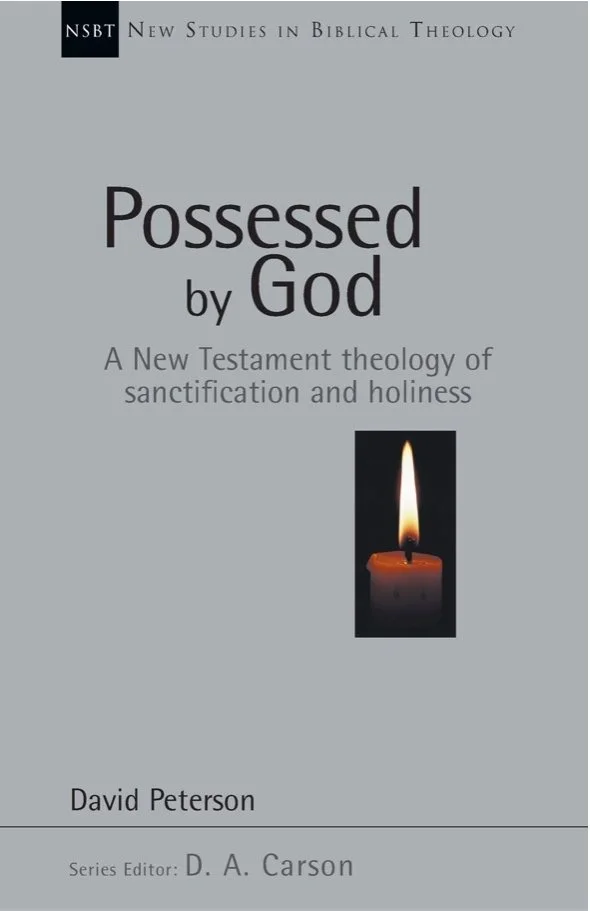
Notes on *Possessed by God*
Possessed by God: A New Testament Theology of Sanctification and Holiness, David Peterson (IVP, 1995)
Main Idea/Takeaway
Moral holiness in the Christian life, typically called "progressive sanctification" is better understood and practiced in the biblical terms of renewal, transformation, and growth — expressions of our definitive sanctification.
"I will argue that definitive sanctification is a more important theme in the New Testament than has generally been acknowledged. Rightly understood, this doctrine is a key to holy living and a way through the impasse created by much previous debate. God calls us and enables us in Christ to live as those possessed by God and empowered by his Holy Spirit. This is the theme of the first three chapters of this book. The fourth chapter then examines New Testament exhortations to pursue holiness and considers the sense in which sanctification is a process of 'becoming' and 'acting'."(14)
"The overall aim will be to hear afresh God's challenge to holiness, encouraged by the promises on which it is grounded and guided by the teaching with which it is associated." (16)
"Sanctification is commonly regarded as a process of moral and 'spiritual transformation following conversion. In the New Testament, however, it primarily refers to God's way of taking possession of us in Christ, setting us apart to belong to him and to fulfil his purpose for us. Sanctification certainly has present and ongoing effects, but when the verb 'to sanctify' (Gk. hagiazein) and the noun 'sanctification' (Gk. hagiasmos) are used, the emphasis is regularly on the saving work of God in Christ, applied to believers through the ministry of the Holy Spirit." (27)
"It would be more accurate to say that renewal and change flow from the regeneration and sanctification that God has already accomplished in our lives." (136)
"Instead of speaking in terms of progressive sanctification, the New Testament more regularly employs the language of renewal, transformation and growth, to describe what God is doing with us here and now." (136)
"In New Testament terms, we are to live as those who have been brought from death to life, discharged from the law to belong to Christ, led by the Spirit in a continuing struggle with the flesh. We are to live with a confidence in what God has already done for us and trust in him to continue his transforming work in us until we see him face to face." (137)
Interaction
The holiness of God, cf. Webster. (16)
"But they are unable to effect such living" (21)
On mission: "Mission is clearly the goal of sanctification in John17." (30)
"Are you living by your assessment of your life or God's?" (49)
"Believe the gospel. Embrace your identity in Christ. Live by God's assessment of your life." (49)
"Think in terms not of measurable maturity, but trajectories of current devotion & practice. The "Pilgrim's Progress" allegory is again masterful." (91)
cf. Beale article: relation between new creation and reconciliation in 2 Corinthians. (133)
Present experience of glorification. (133)
Table of Contents
Introduction
I. The biblical starting-point
II. Sanctified in Christ
III. Sanctified by word and Spirit
IV. Pursuing holiness
V. Living between the cross and the resurrection
VI. Transformation, renewal, and growth
Appendix A: The meaning of hagiasmos in the New Testament
Appendix B: Sanctification and God's law
Favorite Quotes by Chapter
Introduction
"Considering the passion for holiness expressed by writers and preachers in former generations, James Packer may be right to claim that 'holiness is a neglected priority throughout the modern church generally' and 'specifically a fading glory in today's evangelical world' (1984: 99)." (11)
"Despite the significant work of Packer and others, there is room for a fresh look at the subject, with a particular focus on what the New Testament teaches about the way holiness is achieved and expressed."(12)
"The assumption is generally made that sanctification is simply the process by which we become more and more holy." (13)
"It obscures the distinctive meaning and value of the terminology in the New Testament, confusing sanctification with renewal and transformation." (13)
"Sanctification is a state in which believers find themselves because of the work of Christ and the operation find themselves because of the work of Christ and the operation of his Spirit in their lives. They are called to remain in that state 'by living in correspondence to their given holiness' (614)." (14)
"In sum, sanctification in the New Testament is seen as 'a one-time event and as a process, the believers being and becoming holy and acting correspondingly' (614)." (14)
I. The biblical starting- point
"Even though the holiness of God cannot be adequately conveyed in vision or word, angelic beings declared that it could be encountered in our universe, which is like a vast temple dedicated to his use and the display of his glory. God's glory is his holiness revealed."(18)
"The covenant relationship established by God contained at its heart the assurance that he would be their God and they would be his people (e.g. n. 17:7-8; Ex. 6:7). Consequently, he would be uniquely with them, to fulfil his purposes and bring blessing to them (e.g. Gn. 28:13-15; Ex. 3:7-8)." God's sanctifying presence would continue to mark them as a holy people and demand holiness of living as a response." (21)
"Holiness cannot simply be acquired by human effort. It is a status or condition which God imparts to those whom he chooses to bring into a special relationship with himself through covenant and redemption. But it is a status that carries with it particular responsibilities."(23)
"Just as Israel was made holy by God's saving activity in the time of Moses, and again in the restoration after the Babylonian Exile, so sanctification in the New Testament is an integral part of the redemptive work of Jesus Christ. It is regularly portrayed as a once-for-all, definitive act and primarily has to do with the holy status or position of those who are 'in Christ'." (24)
"Christians are sustained in holiness by the ongoing presence of the Holy Spirit and the trust that he gives in the finished work of Christ. The essential work of the Spirit is to enable belief in the gospel, so that the blessings it offers may be continually enjoyed by God's people." (24)
"Christians are called to live out the practical consequences of knowing God in Jesus Christ and of being consecrated by his saving work. Everything that is said about moral change and personal transformation in the New Testament is to be related to God's sanctifying initiative in Christ." (25)
"...sanctification in Christ has to do with a profound re-orientation of values and behavior. Beginning with the 'heart' and reaching out to touch the life and witness of God's people at every level, God's word and God's Spirit bring change and transformation. In us and through us, something of God's holiness is revealed to the world." (25)
II. Sanctified in Christ
"At the heart of the revelation that Jesus brings is the proclamation of God's redemptive achievement in the death of his Son. In his death, Jesus demonstrates the love which God has for the world and which he desires to see reflected in the life of his people. With the gospel message about Jesus and his work, God imparts his Spirit to us and binds us to himself in love. That same word keeps us in holiness and love, enabling us to share in his mission to the world." (33)
"By his sovereign action in Christ, God sets apart and binds to himself those who have been purified from the defilement of sin. This objective, consecrating work of God has profound implications for the attitude and behavior of those who believe." (34)
"Although Israel under the Old Covenant was able to draw near to God through the mediation of priests and the operation of the sacrificial system, the people were not 'perfected' in their approach to God (gf. 7:11; 10:1-2). However, with Jesus, 'a better hope' has been introduced by which we may draw near to him (7:19; 10:14)." (36)
"This better hope is based on the 'better covenant', which has been enacted through 'better promises' (8:6). Here and now, we are 'qualified' to draw near to God with the certainty of sins forgiven and the confidence that we are in an eternally secure relationship with God (c/. 7:19; 9:9; 10:1-4, 14-23; 12:22-24). Our hope is also to meet God face-to-face, in the glory of his eternal kingdom (c/. 2:10; 4:9-10; 12:14, 22-24; 13:14), and so perfection in Hebrews involves ultimate glorification. Even so, what we have yet to experience is only an unfolding of what has already been achieved for us by Christ's sacrifice." (36)
"The terminology of perfection is used to proclaim the fulfilment or consummation of men and women in a permanent, direct and personal relationship with God."(36)
"Jesus' death brings about a cleansing from sin and a definitive consecration to God in the present. It also secures for us a share in the future that God has promised. We can draw near to God now with the directness and certainty that belong to the final state of his people (cf. 4:16; 10:19-22: 12:22-24). The perfecting of believers involves all of that. Our sanctification or consecration to God is only a part of the process of eschatological perfection, achieved through the perfecting of Christ (2:10; 5:9; 7:28)." (37)
"The New Covenant promise of a renewed 'heart' is fulfilled when people are set free from the burden of unforgiven sins through trusting in the effectiveness of Christ's sacrifice (9:14; 10:22). They are thus renewed in faith and sincerity towards God. Only the cleansing provided by Christ can definitively free us to worship or serve the living God (9:14, Gk. latreuein) in a way that pleases him and truly honors him." (39)
"Sanctification means being appropriated by God and dedicated to him by the saving work of his Son. The terminology is associated with the beginning of the Christian life and highlights the corporate dimension to sanctification in Paul's thinking. Sanctification has to do with the identity and status of those who are 'in Christ'. It also points to the lifestyle that is consistent with God's calling." (40)
"The next clause, 'to those sanctified in Christ' (Ck. hegiasmenois en Christo), amplifies what it means to be God's church. The Corinthian Christians were a holy and distinct people in that corrupt and godless city. This was so because of God's initiative, drawing them into an exclusive relationship with himself.? What he had done for them "in Christ Jesus' had made them part of his eschatological community. Here the perfect passive participle "sanctified' should be understood as another way of speaking about their conversion and incorporation into Christ. It can hardly refer to their holiness of character or conduct, since Paul spends much time in this letter challenging their values and their behavior, calling them to holiness in an ethical sense. He does this on the basis that they are already sanctified in a relational sense, but need to express that sanctification in lifestyle." (41)
"Jesus delivers us from the dominion of sin and death (redemption). By his righteousness he also makes it possible for us to be counted righteous by God (justification). At the same time, he establishes us in a distinct and exclusive relationship with the Holy One (sanctification). In the great Christological statement of 1 Corinthians 1:30, redemption, justification and sanctification are overlapping, but distinct theological concepts. This judgment is confirmed by the argument in 1 Corinthians 6:11." (44)
"The Spirit's work is to empower the preaching of the gospel about Jesus, enabling those who hear to understand and believe (2:4-5; cf. 2:6-16). So the Spirit is the means whereby God in the present age 'effects the work of Christ in the believer's life' (Fee 1994: 219)." (47)
"Sanctification is about being possessed by God and expressing that distinctive and exclusive relationship by the way we live." (48)
III. Sanctified by word and Spirit
"Here it is important to note that everything in the Christian life, from beginning to end, is made possible by Jesus' self-giving in death (Eph. 5:25), previously described as 'a fragrant offering and sacrifice to God' (5:2). Only those who are sanctified by Christ now can be presented to him in glory then. Transformation is implied by the notion of glorification (cf. Rom. 8:29-30; 2 Cor. 3:18; 1 Jn. 3:2), the present work of the Spirit anticipating the ultimate transformation associated with the resurrection of our bodies." (54)
"By faith in the gospel, we continue to be united with Christ, which is the heart of sanctification. By faith, we rely on his promises and grasp the power of his Spirit, so that we can resist sin and live for God. This theme will be particularly developed in chapter five. Faith is 'not only a receptive organ but also an operative power." (56)
"When God sanctifies us as individuals, he establishes us as members of a holy fellowship, enabling us to play our part in maintaining and expressing the holiness of the church, in doctrine and lifestyle." (67)
IV. Pursuing holiness
"So the challenge is to pursue practical expressions of the holiness or sanctification that is ours in Christ." (75)
"Those who are cleansed and consecrated by Christ, and who look forward to sharing the perfection of holiness in his presence for ever, will pursue holiness as a lifestyle." (77)
"Indeed, the Spirit he gives to Christians is the Spirit of holiness; and nothing unholy can be tolerated in the lives of individuals or communities where the Holy Spirit dwells (gf. 1 Cor. 3:16-17; 6:19-20; 2 Cor. 6:14-7:1)." (84)
"The promises about God dwelling in the midst of his people, and welcoming as his sons and daughters those who separate themselves from everything unclean (6:16-18), are the motivation for a holy and separated life." (87)
"From a positive point of view, the secret of a holy life is reflecting the character of God, knowing that his Spirit is at work amongst his people to make that separate and distinct lifestyle possible, and thus walking in the Spirit's ways. When they ignore these imperatives, believers dishonor the one who called them into an exclusive relationship with himself and compromise the holiness of the church as 'the temple of the living God' (6:16; cf. 1 Cor. 3:16-17; Heb. 12:15)." (88)
"No Christian should doubt the need to give practical, everyday expression to the holiness that is our status and calling in Christ. Only those who trust in his sanctifying work on the cross, and take seriously the warning to 'pursue holiness', will 'see the Lord'." (91)
"On the other hand, it is possible to be so zealous for 'progress' that one's attention shifts from God's grace to human effort. Moral growth and development will be God's gift to us at different stages of our lives, but spirituality must not be measured in terms of the rate of change. We are to go on exhibiting what we know of God's character and will, motivated by the certainty of his acceptance, cleansing and enabling in Christ, together with the promise of entire sanctification when we meet him, face to face. Progress may be seen as we exercise ourselves in that godly devotion which issues from a true knowledge of God in Jesus Christ." (91)
V. Living between the cross and the resurrection
"When he moves to consider how justification by faith can lead to holiness of life, Calvin emphasizes the role of repentance. Repentance not only follows faith but is born of faith. Repentance means the true turning of our life to God, a turning that arises from a pure and honest fear of him' (Inst. 3.3.5). It consists in 'mortification of our flesh and of the old man' and in 'vivification of the Spirit'." (93)
"In this chapter, I want to explore the idea that moral renewal proceeds from our union with Christ in his death and resurrection." (95)
"Baptism into union with Christ is the way we identify with him in his epoch-changing death and draw on its benefits. Of course, conversion and water baptism are often separated in Christian experience. But Paul's point is that genuine initiation into Christ means trusting in his death as our death and his risen life as our life. In this respect, baptism is presented as our 'funeral rite' and a decisive break with the life and values of this present age." (97)
VI. Transformation, renewal, and growth
"What makes me a new person in Christ is essentially faith in God and his promises. The Spirit's ongoing task is to renew my "mind' through the gospel and give me a new 'heart' to serve God in faith and obedience. Renewal of mind and heart transforms character and behavior because of the central place that the mind has in the orientation, attitudes and beliefs of the human personality. Renewal is not simply at the rational level, though this is foundational to the whole process of moral renewal and change that is effected by the Spirit. In the final analysis, renewal is the present experience of glorification through the Spirit, anticipating the glorification that will come with the resurrection of our bodies. It is being conformed to the likeness of Christ, who is himself the image of God."(133)
"If we are definitively sanctified by the work of Christ and the gift of his Spirit, 'growth' in holiness will mean increasing and abounding in practical expressions of that status calling and commitment which is already ours by God's grace." (136)
Notable Content
Definitive Sanctification explained. (14)
"To what extent are we urged by Scripture to progress in holiness and in what manner? How should we pray for one another in this regard? How might we expect God to answer our prayers?" (71)
Understanding Hebrews chapter 12. (75)
Four senses in which Christians die to sin. (97)
Brief comments on the concept of growth in the New Testament. (134)

Notes on *Ploductivity*
Ploductivity: A Practical Theology of Work and Wealth, Douglas Wilson (Canon Press, 2020)
Main Idea/Takeaway
Technology in all its forms is a type of wealth, and we are called to steward it well- which means productivity.
"Technology is a form of wealth; progress is a form of wealth."(57)
"And so here is my central thesis, stated yet again: technology in all its form is a type of wealth." (99)
Table of Contents
Part I: A Theology of Productivity
An Introduction to Technofullness
I. A Theology of Work
II. A Theology of Wealth
III. A Theology Tools
IV. A Theology of Media
V. A Theology of Missions and Media
VI. A Theology of Markets
VII. A Theology of Progress
VIII. A Theology of Glad Suspicion
Part II: Learning Ploductivity
IX.The Finitude of Work
X. Ambition is a Good Thing
XI. The Master Key
XII. The Power of Plodding
XIII. Work at a Pace You Can Maintain
XIV. Progress and Depravity
XV. Eschatology
XVI. New Media
Favorite Quotes by Chapter
An Introduction to Technofullness
"As Peter Drucker said, "Efficiency is doing things right; effectiveness is doing the right things."(7)
"But I sincerely hope, at least for a number of you readers, this will be the last productivity book you read. Not because I have discovered the Lost Technique that once made Atlantis great and which I am about to share with you all for a modest fee, but rather because I hope this book will help you deal with the issues surrounding productivity in such a way as to help you mortify that most peculiar lust." (8)
"If we get the theology of the thing right, then it should be something that our great-grandchildren can apply fruitfully fifty years from now when they are trying to incorporate who-knows-what into their daily lives. It probably won't be the iPhone 92." (10)
"We have a perennial temptation to locate sin as resident in the stuff. Some refuse to see sin in the stuff, and therefore conclude that there must not be any sin. These are the technophiles. Others see clearly that there is sin, and so they conclude that it must be in the stuff, though maybe it is not in the earlier stuff. These are the technophobes." (10)
"Technology is therefore a form of wealth. The reason this is important is because the Bible says very little about technology as such, but it gives us a great deal of blunt and pointed teaching on the subject of wealth. If we learn how to deal with wealth scripturally, then we will have learned how to deal with technology." (11)
"This is what I mean by ploductivity. This is deliberate faithfulness: working in the same direction over an extended period of time. Our electronic servants may be super fast, but we should be as deliberate as ever." (11)
I. A Theology of Work
See Notable Content for "What does good work look like?"
"We are saved by grace, but grace works."(19)
"We are not saved by good works (Eph. 2:8-9), but we are saved to good works.(Eph. 2:10)" (20)
II. A Theology of Wealth
"Wealth- monetary, technological, or otherwise- is simply and solely a good thing, a gift of God. The sin enters in when the means of self-sufficiency are placed in the hands of someone who has entirely the wrong attitude about autonomous self-sufficiency." (21)
"The arrogant human heart is the source of the sin concerning wealth, and the arrogant human heart sins this way in the proximity of wealth. Wealth is not the locus of the sin, but the presence of the wealth is the locus of the temptation." (23)
"The solution to self-sufficiency is not to banish the goods that we used to forget God, but rather to make a point of remembering God in and through the abundance He gave to us." (25)
"We are not only tempted by wealth, we are tempted to blame wealth. It can be a sin to misunderstand the nature of sin. In other words, we are tempted to locate the sin in the stuff, and then we try to solve the problem (when and if we do try to solve it) by putting some kind of respectable distance between us and the stuff. If people sin with alcohol, tobacco and firearms, and they do, then we think we must regulate the substances (or the tools) themselves." (25)
"If I were to make a decision to throw my old heart away, that decision would have to be made by my old heart. And if my old heart could do something as wonderful as throwing my old heart away, what is the need for a new heart?" (25)
III. A Theology Tools
"In order to evaluate a tool, we have to account for the telos, the end, the purpose. Hammers are used to build both brothels and barns." (29)
"When we sin with a material object, or in near proximity to a material object, the most obvious thing to occur to us is to blame that material object." (29)
"Tools enable us to widen our reach. Tools make it possible for our radius of fruitfulness (now there is a phrase for the ages_ to extend much farther than it otherwise would. So when Adam found the beehive-knocking-down stick, he was wealthier than he was before. When a man purchases an app for 99 cents, he is wealthier than he was before. Tools are technology, and technology is a form of wealth." (32)
"We should regard tools the same way we regard our money- with grateful suspicion. Or perhaps, on alternating weeks, with suspicious gratitude." (32)
IV. A Theology of Media
"I would define media in this way: working out from and including our bodies, media also include our clothes, other people, and tools, including especially tools for communication and infrastructure." (34)
"God was the one who told us to multiply. And one of the things that necessarily grows and develops with that multiplication is the largely invisible world of media. When we notice it, which happens rarely, our reflex action is to worry about it- as though getting your news off a smartphone is somehow less "authentic" than getting it from newsprint, telegraphs, or smoke signals." (37)
"But when we see that tools are a subset of media, and that media were obviously a gift from God, given to us through the mere fact of creation, we should become much more comfortable with the idea of tools as essential to our humanity." (37)
V. A Theology of Missions and Media
"When Jesus spoke these words, going into the world meant what we would call travel (going from one place to another yourself), and it meant communication across distance (going from one place to another by means of media). Communication media at the same time largely meant letters, or epistles. We still have the same basic options- travel and communications media." (40)
"So what should we bring with us when we travel? What should we send with our messages when we write? The answer is Jesus, but this must be understood rightly." (40)
"The fact that we have greatly accelerated the pace of these two functions (travel over distance and communication across distance) is nothing new in principle." (41)
"Your country can only export whatever it is your farmers are growing. When you go somewhere, or when you send a message somewhere, you are simply projecting what you already are." (42)
"If you are alive, vibrant, and forgiven, you now live in a world where you can project that in amazing ways." (42)
VI. A Theology of Markets
"Control of the future is actually a (vain) attempt to control people, with the future as our instrument." (47)
"Two words that do not go together are control and future. The future, like salvation, is the gift of God, and it must be apprehended by faith alone." (48)
"The two issues mentioned earlier that underlie economics are first, the need for us to respect the free choices of others, and second, to use our own power of free choice to investigate the fruitful world God gave to us." (48)
"The free market does not decide the price of the new zippers. That decision is made by the Lord Jesus. A statement like that hits us sideways because we are accustomed to think about the world in a quasi-Diestic terms. Sure, God made everything some time long ago, but things happen now because of impersonal natural laws, right? Gravity pulls things to the floor, centrifugal force pulls them out to the edges, and the law of supply and demand determines the cost of zippers. But the biblical doctrine is actually one of creating and ongoing providence. All of it is personal." (49)
"We are to put our hand to the work, doing the best we can with it, and we are to keep our hands off the future." (50)
"My responsibility is, so to speak, whatever is in front of me, there on my workbench or desk or counter. I should do a first-rate job with that, and other things will fall into place. And as they fall into place, it will not be the impersonal doing of Adam Smith's invisible hand. Every blessing a Christian ever receives is from a pierced hand." (50)
VII. A Theology of Progress
"Wealth is the technical ability to summon the labor of others, either in person or through the application of tools, but the person in possession of that wealth has to have the ability to know how to do it." (53)
"If you are anything like me, you need to learn how to manage this embarrassment of wealth. In short, you need to learn how to become more productive." (55)
VIII. A Theology of Glad Suspicion
"The Bible does teach us what our orientation toward health should be- that of glad suspicion, or maybe, on our gloomy days, suspicious gladness." (57)
"The technophile just assumes that man is the measure of all things, and he plumps his resume in order to get a job with Google, so that he too may become one of the lords of the earth. The technophobe just memorizes the poetry of Wendell Berry, and yearns for the days of yesterday when all our food was eked out under a hot sun by a slow mule and a picturesque peasant staggering behind it. Both are forms of ingratitude; both are grotesque. The only obedient response is to accept that wealth as the gift of God that it is, and to keep it in its proper creaturely place." (59)
"Although there is a bias toward sin in the possession of such blessings, it is important to emphasize by means of reiteration that sin is not resident within the things themselves. In this respect, it is like the old covenant- God finds fault with the people (Heb. 8:7-8). There is no sin in immunizations, in iPhones, in Google searches, in air travel, or in Lasik eye surgery. To the extent it is progress, it is the result of God's kindness as mediated through our culture as fruit of the gospel." (59)
"To whatever extent it is not a blessing, it is not progress. If it is progress, then we must thank God for it- He is the one who gives us the power to get wealth, and there is no appropriate or safe response to that wealth other than complete and simple gratitude." (61)
"It does not profit a man to gain the world and lose his soul, and there is an additional sting when he then loses the world too. Whatever to worship in place of God is another thing you lose. Whatever you surrender gladly to Him is returned to you, pressed down, shaken, and running over." (62)
"There is not one blessing we enjoy that was not given to us by the hand of Jesus Christ. If we insist on ignoring His lordship, his blood, His authority, and His kindness, then the time is coming, and now is, when He will chastise us by taking it all away. If we seek the Kingdom, then other things will be added. If we don't acknowledge Him, worship Him, or bow down before Him, He takes away that which was blocking the view, which in our case is all our stuff." (62)
An Introduction to Ploductivity
"Living and working in the presence of God is essential because what constitutes a truly productive person is the fact that they are laboring under the blessing of God." (68)
"Living in the presence of God means that you are living in such a way as to invite or seek His favor. The Sabbath and the tithe illustrate well the trust we are to display in this. Would you rather work hard for seven unblessed days or work hard for six blessed days? Would you rather try to live on 100% of an unblessed income or on 90% of a blessed income?"(69)
"Pray that God establish the work of your hands, and not just the work of your heart. This is not a facile "health and wealth" approach because God is not to be treated as some kind of a vending machine. God's blessing includes both temporal victories and temporal defeats, and evangelical faith knows how to handle all of it." (69)
IX. The Finitude of Work
"Too many people confound our finitude with our sinfulness, but the breach between us and God is one that was caused by our unholiness, not by our size. Before Adam sinned he was just as small as the day after he sinned, but he was still able to walk with God in the garden in the cool of the day. Our size is a feature, not a bug." (72)
"We are God's workmanship, created in Christ Jesus to do good works, which God prepared beforehand for us to do, God is up to something big- He has a cosmic project in view- and not one of us knows the fullness of what that is." (72)
"When God created ex nihilo, He was doing all the work. When we work as sub-creators, to use Tolkein's word for it, we are dealing with pre-existent materials and processes. This is because God is using the miniscule works that we are performing to teach us to trust Him, and to teach us the meaning of work." (74)
"Remembering the finitude of your labors will keep you humble. Recognizing that your labors have a place in God's cosmic intentions for the universe will keep you from thinking that your tiny labors are stupid labors. They are nothing of the kind. Your labors in the Lord are not in vain (1 Cor. 15:58)." (74)
X. Ambition is a Good Thing
"The true Christian is characterized, not by a lack of desire, but rather through a desire that is calibrated to its appropriate object, which is ultimately Christ." (76)
"Many Christians think their problem lies in the verbs, when it actually lies in the direct objects and in the adverbs. They think they are to be faulted because they want , because they desire. But the actual problem is not that we desire, but that we desire the wrong things, or that we desire the right things wrongly." (77)
"Setting ambitious goals is therefore a good thing, and determining whether or not we are desiring something sinful, or desiring it sinfully, is heart work. We do that heart work by praying to the Lord about it, by reading the Word faithfully, looking to be instructed, and by worshipping God together with Hid people, gathering regularly to be edified by Word and sacrament." (78)
XI. The Master Key
"It is impossible to read through the Scriptures and come to the conclusion that the Lord thinks slipshod work is good enough." (80)
"Learn what good work is, imitate it studiously, and do that over time." (82)
XIII. Work at a Pace You Can Maintain
"The thing to take away is that brief but daily routines are capable of accumulating a large amount of whatever the work product might be. A man could take out the trash every evening, and while out there quietly lay one brick, and after six months present his with with a brick wall along the alley- something she never even knew she wanted." (94)
XIV. Progress and Depravity
"The birth of the modern age, measured in terms of conveniences, technology, wealth, medical advances, and so on was largely a legacy of the Reformation. But the Bible teaches that whenever a gift is given, there will immediately be a temptation arising in our hearts to steal the glory and gratitude that should go to God alone." (95)
"A commons worry among modern sophisticates is that technology really is making us stupid. It would be better to say that technology when ignored or mismanaged makes us stupid, but this has always been the case with every form of wealth." (97)
"The world, this world, is presently going where Jesus is taking it. So we should be wise, and stop worrying." (99)
XV. Eschatology
My optimism about tools and technology is, at bottom, an optimism that is grounded on the fact that at the darkest point in human history, God in the flesh was crucified by arrogant sinners, by all the important people. Three days after that, the Lord came back from the dead. That means that the world has been overthrown. How could that world not be overthrown? That world is dead because its only power was death, and we serve a Lord who went into death's maw, and then came out again. That is the ultimate plot turn. That is the central fact of all human history." (103)
XVI. New Media
"When the bank robber Willie Sutton was asked why he robbed banks, his reply was "Because that's where the money is." Christians should go with our life-transforming message, and where should we go? Where the people are."(106)
"We proclaim the lordship of Christ over everything, and we do so, not because we have invited Him into our hearts, but rather because He rose from the dead, ascended into the presence of the Ancient of Days, and was given a universal and cosmic authority Dan. 7:13-14)." (107)
"Jesus is already Lord of those who recognize it, and He is already Lord of those who refuse to recognize it. This means that the authority of Jesus Christ, right now and not later, currently extends over Facebook, Google, and Twitter." (107)
"So wherever people are, Christians should be right there, with all our work, talking about the Lord. You know, theLord. The Lord over all of this." (108)
Notable Content
"I am seeking to stake out an entirely different third position, over against the twin errors of technophobia and technophilia." (9)
What does good work look like? (17-18)
"First, work is a good thing, and the hard way is actually the easy way."
"Second, the right kind of work- when a particular result is desired- quenches the wrong kind of desire."
"Third, the Bible teaches that diligence and laziness are visible."
"Fourth, the diligent like to have their work speak for them, and unproductive men like to substitute talk for action. Lazy men are good talkers."
A description of the man hours required in just the manufacturing of a No. 2 pencil. (52)
"A good example of an erudite worrier would be Neil Postman in Amusing Ourselves to Death. But for every book like that, given the propensity of Calvinists to worry excessively about the heart of man, I would recommend that you read three like Johnson's Everything Bad is Good for You, Postrel's The Future and Its Enemies, and Herman's The Idea of Decline in Western History." (102)

Notes on *Men and Women in the Church*
Men and Women in the Church: A Short, Biblical, Practical Introduction, Kevin DeYoung, (Crossway, 2021)
Main Idea/Takeaway
Complementarity is the biblical vision of men and women, rooted in God's natural design and good for life in general and the ministry of the church.
"This book is about the divinely designed complementarity of men and women as it applies to life in general and especially to ministry in the church." (15)
"Raise up a new generation of cheerful and unflappable Christians who will celebrate a vision of manhood and womanhood that is not only biblical but in a profound sense natural as well." (133)
Interaction
Who is the loudest, driven by the most rage, with popular culture on their side? (18)
Table of Contents
Introduction
Part 1: Biblical Exploration
I. A Very Good Place to Start
II. Patterns That Preach
III. Revolution and Repetition
IV. Of Heads and Hair
V. A Marriage Made in Heaven
VI. The Heart of the Matter
VII. Leaders, Servants, and Life Together
Part 2: Questions and Applications
VIII. Common Objections
IX. Growing Up as Boys and Girls
X. Following Christ as Men and Women
Favorite Quotes by Chapter
Introduction:
"God decided to make not one man or one woman, or a group of men or a group of women; he made a man and a woman. The one feature of human existence that shapes life as much or more than any other- our biological sex- was God's choice." (13)
"The whole human race is, always has been, and will be for the rest of time, comprised of two differentiated and complementary sexes." (14)
"The fact that God created man as a plurality- male and female, a complementary pari- ought to shape not only how we conceive of marriage but how we conceive of ourselves." (17)
"It's one thing to be convinced that complementarian exegesis is correct; it's another to be sure that it is good." (17)
"The truest form of biblical complementarity calls on men to protect women, honor women, speak kindly and thoughtfully to women, and to find every appropriate way to learn from them and include them in life and ministry- in the home and in the church." (17)
I. A Very Good Place to Start
"Every other aspect of creation had its counterpart. The day had its sun, the night its moon, that waters its fish, the sky its birds, and the ground its animals, but the man did not have his helpmate." (24)
"Whatever "rules" there are for men and women in the church are never mere rules: they reflect the sort of differentiated and complementary image bearers God designed us to be from the beginning." (25)
"Men and women, as distinct from all else in creation to testify to the world that God has dominion over this place. As image bearers, not to mention coheirs of the grace of life (1 Peter 3:7), men and women possess equal worth and dignity." (25)
"The opening chapters of the Bible establish the shape of sexual differentiation and complementarity that will be lived out, applied, and safeguarded in the rest of Scripture." (33)
II. Patterns That Preach
See Notable Content for five patterns in the Old Testament that shape how we think about sexual differentiation and complementarity in life and ministry: (36-41)
III. Revolution and Repetition
"Jesus, of course, came to save men and women. But in coming as a man he literally embodied what true manliness was meant to be- saving, protecting, rescuing, leading, teaching, and serving. Sot it makes sense that while Jesus honored women and empowered them for ministry, when it came to selecting those for positions of authority, he chose only men. There is no one more pro-woman than Jesus, and no one- by his example and in his very person- who did more to affirm true manhood either." (47)
IV. Of Heads and Hair
See Notable Content for six key exegetical questions pertaining to male headship and head coverings: (50-59)
"Paul allowed women to prophesy but did not allow them to join in the weighing of prophesy." (59)
"Whatever we make of New Testament prophecy in relationship to Old Testament prophecy, it is undoubtedly the case that teaching and prophecy in the early church were not identical kinds of speech. As we will see later, elders do not need the gift of prophecy, but they must be able to teach (1 Tim. 3:2). (60)
"Teaching- passing on the apostolic deposit while explaining and applying Scripture- was authoritative instruction in a way that prophecy was not." (61)
"The explicit situation in which women must be silent is where prophecies are being evaluated. Such evaluation would have involved teaching and the exercise of authority (over other prophets), two activities Paul consistently denies to women." (62)
V. A Marriage Made in Heaven
"It may sound archaic, if not fundamentally sinister, but God's design for the home is a thoughtful intelligent, gentle submissive wife and a loving godly, self-sacrificing, leading husband. Whether we live in the first century or the twenty-first century, Ephesians 5:22-33 is God's good plan for marriage: wives, submit to your husbands; and husbands, love your wives." (64)
"The commands to submit and love are intended to reverse the curse inflicted in the garden of Eden." (64)
"The inclination of a sinful wife is to rebel against her husband's authority and try to control him. Paul's commands aims to reverse the effects of the curse and have Christian wives submit rather than usurp. Likewise, men, who are supposed to lead and protect and provide for their wives, now, tainted by sin, treat their wives harshly. The inclination of the sinful man is to exercise ungodly rule over his wife. Paul's commands aims to reverse the effects of the curse and have Christian husbands love rather than domineer." (64)
"God is trying to show something in our marriages. If we disallow sexual differentiation, we are not allowing to shine forth the very heart of marriage itself. Yes, God created marriage for companionship and for sex and for children, but most of all, he created marriage to reveal the profound mystery of Christ and the church. This is a high calling. His plan is for a watching world to look at husband and wife and see such gentle, joyful submission and such self-denying, loving leadership that it gets a picture of the beauty that is the relationship between Christ and his church. Nothing less than God's full glory is at stake."(74)
VI. The Heart of the Matter
"Quietness or silence (2:12) is not meant to be demeaning. Both are positive qualities for the learner (see Eccles. 9:17). And as we've seen from 1 Corinthians 11 and 14, silence is not an absolute command encompassing every element of corporate worship. Silence, in this text as well as 1 Corinthians 14, refers to the teaching ministry of the church. In the context of corporate worship, women are not to be teachers, but quiet learners." (79)
"In the Pastoral Epistles, Paul issues a command or a command-idea (like "I do not not permit") followed by gar twenty-one times, all of which require the casual sense. It is best, therefore, to keep the normal sense of gar and see "for" in verse 13 as introducing Paul's reasons for verses 11 and 12." (84)
"Adam was supposed to be the head, responsible for loving leadership and direction. But he abdicated his role, and Eve's leadership influenced him for evil. As a result of this role reversal, sin entered into the world. On this understanding, Paul is pointing to the difference between the two guilty persons: Adam sinned openly, but Even was deceived. In highlighting this difference, Paul may be grounding his argument in God's design for men and women, which was tragically supplanted in the fall." (85)
VII. Leaders, Servants, and Life Together
"Elders should be students of the Bible and men of exemplary character. They will be spiritual leaders. An elder must be able to teach (1 Tim. 3:2), something not required of deacons. Teaching does not have to mean lecturing in a classroom or giving a sermon, but it does mean that elders must know their Bibles, know theology, be able to discern truth from error, and know how to communicate it to others."
"I'm convinced that in most cases if men behave and lead as godly, humble, self-sacrificing biblical men, then women will happily live and flourish in the responsibilities God has designed for them. The biblical burden of this chapter, this first section, and really this whole book, rests primarily with men." (98)
VIII. Common Objections
See Notable Content for Common Objections
IX. Growing Up as Boys and Girls
"So what I might tell my children about being a man or a woman? I'd try to make it simple as their ABC's: Appearance, Body, Character, Demeanor, Eager Posture." (118)
"Yes, the cultural winds are blowing stiff and strong against the church on these issues. But the good news is that behind us lies a massive river of divine design in every human person. Ultimately, God's created order cannot be reengineered by sinful human ingenuity. Manhood and womanhood will reassert themselves. The question is whether it will be healthy or unhealthy. God made us as men and women to act like men and women. The more we see in nature (partly) and in God's word (mainly) what it means to be men and women, the better our marriages, our children, our churches, and our society will be." (129)
X. Following Christ as Men and Women
"Faithfulness does not mean returning to some supposed golden era rooted in a particular cultural moment, nor does it mean making as many enemies as possible in this cultural moment, but it does mean that for the sake of the good, the true, and the beautiful, we will not shrink from facing opposition when it is impossible to avoid." (132)
"The Reformed tradition has always been adamant that grace does not eradicate nature or elevate nature, but grace restores nature. God is in the business of returning us to what was once declared "very good." That means that while male and female are nothing when it comes to being justified in Christ, the fact that we were created with a specific sex has everything to do with living as justified Christians." (132-133)
"Any attempt to recover biblical manhood and womanhood, or any efforts as Christians to recover from the recovering, must start with the recognition that sexual difference is not simply a marker of who may hold the office of elder; it is an indication of the sort of image bearer God wants us to be in all of life." (134)
"There are differences in the place men and women occupy in the church and in the home. If the husband is called to be the head of the family, then the wife is called to be its heart." (135)
"No doubt, there may be a cost- personally, vocationally, culturally- when we embrace sexual differentiation and complementarity, but let us never forget that the law of the Lord is perfect, the testimony of the Lord is sure, the precepts of the Lord are right, and the commandment of the Lord is pure (Ps. 19:7-8)." (136)
Notable Content
Five patterns in the Old Testament that shape how we think about sexual differentiation and complementarity in life and ministry: (36-41)
Pattern 1: Only Men Exercising Official Leadership
Pattern 2: Godly Women Displaying a Wide Range of Heroic Characteristics
Pattern 3: Godly Women Helping Men
Pattern 4: Ungodly Women Influencing Men for Evil, Ungodly Men Mistreating Women
Women Finding Pain and Purpose Associated with Bearing and Caring for Children
Six key exegetical questions pertaining to male headship and head coverings: (50-59)
Question 1: What does it mean that the husband is the head of his wife?
Question 2: What is the covering?
Question 3: What "head" does the woman dishonor?
Question 4: What does Paul mean by "authority"?
Question 5: What does Paul mean by referring to "nature itself"?
Question 6: How can Paul command women to be silent in the churches in 1 Corinthians 14 when he regulates women praying and prophesying in 1 Corinthians 11?
Paul's two reasons for verse 11 and 12 in 1 Timothy 2 (84)
Order of Creation
Eve was Deceived
Common Objections (101-115)
Objection 1: Galatians 3:28
Objection 2: Ephesians 5:21
Objection 3: Slavery
Objection 4: Women in Ministry in the Bible
Objection 5: Gifts and Calling
The Nature of Things (133)
See Appendix (139-152)

Notes on *Hearers and Doers*
Hearers and Doers: A Pastor's Guide to Making Disciples Through Scripture and Doctrine, Kevin J. Vanhoozer, (Lexham Press, 2019)
Main Idea/Takeaway
Pastors must be theologically rooted to help church members recover the primacy of Scripture in their discipleship.
"Hearers & Doers is intended to help pastors fulfill their Great Commission to make disciples, with emphasis on the importance of teaching disciples to read the Scriptures." (Preface xi)
"My hope is that the present book will help pastors recover Calvin's vision for theology as a help to reading the Bible in ways that enliven and encourage disciples to walk its way of wisdom." (Preface xxii)
"To make disciples is to teach people how to become biblically literate so they can be effective inhabitants and representatives of the city of God, for the purpose of gospel citizenship." (71)
"Accordingly, this book is a guide for hearing and reading the Bible rightly, as well as a training manual for doing the Bible rightly. The goal is to train disciples to walk around in the strange new world of the Bible even as they live in the familiar old world of the present. It is a pastor's guide for training hearers and doers, faithful followers of Jesus Christ and faithful interpreters of the Word that directs us in his Way." (71)
"I want to examine the significance of sola Scriptura in making disciples by stressing its role in fostering the Christocentric social imaginary that makes the church a creature of the word." (99)
"A pastor does many things, but I have argued that most of these things are forms of ministering God's word: either by speaking (preaching, teaching, counseling, praying) or enacting it (celebrating the Lord's Supper, visitation). The particular focus of the present work has been on the pastor as disciple-maker, or what I have described elsewhere as "public theologian"- one who does theology with and for people." (241)
Interaction
Social imaginary = deep assumptions. (8)
The negative task of theology. (9)
What other words are shaping our people? (50)
Pastors minister by helping people make connections in three key areas. (117)
What is a pastor-theologian? (123)
If we don't mature immature Christians into real disciples, who will? The church is where this must happen. This goes for all 'immature Christians' that make up a congregation. The consumers, the feminists, etc. Where do they go to become disciples? It must be the church. And so the stronger brothers must bear with the failings of the weak. (Romans 15:1)." (125)
Preach the Bible; baptism and Lord's Supper; and people are not part of the church who shouldn't be. (127)
This is our consumer culture, which is not 1 Timothy 6:8. (146)
Credo-Baptism see p.218. (150)
Lord's Supper see p.221. (151)
"The church is most itself at Table." (221)
Table of Contents
Introduction
Part One: Warming Up: Why Discipleship Matters
I. The Role of Theology in Making Disciples
II. Whose Fitness? Which Body Image?
III. From Hearing to Doing
IV. Doctrine for Discipleship
Part Two: Working Out: How Discipleship Happens
V. Creatures of the Word
VI. Company of the Gospel
VII. Communion of Saints
VIII. Children of God
Favorite Quotes by Chapter
Introduction:
"In short: what it means to be biblical is inextricably related to what it means to be Jesus; disciples, and what form this discipleship should take in the twenty-first century." (xviii)
"Doctrine, like Scripture, teaches disciples who they are "in Christ." Disciples have to understand, and remember, whose Way they belong to." (xviii)
"Why should pastors study theology? So that they can better know whom they worship, and learn how to form others into true worshipers who know how to worship, and to walk, in spirit and truth (John 4:22-24)." (xxi)
"Theology is about learning how to live out Christ's life in us (Gal 2:20), a life that includes cruciform wisdom (1 Cor 2:2) and resurrection power (Phil 3:10)." (xxiii)
"The aim of evangelism is to make converts, people who believe the gospel, repent of their former way of life, a bonfire of the vanities, and face a new direction- Christward." (xxiv)
"Making disciples involves more (but not less) than informing minds or forming habits. It also involves transforming imaginations, that is, that primary ways they see, think about, and experience life." (xxv)
"The pastor must be a theologian: someone who can relate life in general, and the lives of his congregation, to what Scripture shows us the Father doing in Christ through the Spirit to renew creation." (xxvii)
Part One
Warming Up: Why Discipleship Matters
I. The Role of Theology in Making Disciples
"There is probably no more damaging picture distorting our present-day lives, and our understanding of the God of the gospel, than "love." Love is often depicted as a desire to be fulfilled (romanticism) or as accepting people for who they are (inclusivism) or as loyalty to one's own people group (tribalism)." (7)
" A social imaginary is the picture that frames our everyday beliefs and practices, in particular the "ways people imagine their social existence." The social imaginary is that nest of background assumptions, often implicit, that lead people to feel things as right or wrong, correct or incorrect." (8)
"The doctrines we hold be they philosophical, political, or theological, feel right or wrong, plausible or implausible, based largely on how well they accord with the prevailing social imaginary or world picture. What I have called above the "negative task" of theology is to critically reflect on the way in which the church embodies the prevailing social imaginaries of the day rather than the biblical imaginary- the true story of the Triune God is doing in the world." (10)
II. Whose Fitness? Which Body Image?
"Theology helps the church make disciples by exposing the lie- the false social imaginaries that often hold even church members captive (the negative, critical task) - and by redirecting them to the way, truth, and life of Jesus Christ (the positive, indicative task)." (14)
"Food cults arguably replace what religion once did by prescribing... food rules and rituals. Like religion, they provide meaning in confusing situations, giving us moral guidelines and comfort." (27)
"Pastors, too, ought to be concerned with the diet of their congregation, particularly if we stretch the term to include what kind of reading and entertainment church members imbibe on a regular basis."(42)
III. From Hearing to Doing
"Discipleship is about becoming who we are in Christ, and this is entirely a work of God: "Therefore, is anyone is in Christ, he is a new creation" (2 Cor 5:17)." (44)
"Discipleship is essentially a matter of hearing (authority), believing (trust), and doing the truth (freedom) that is in Jesus Christ." (50)
"As Dietrich Bonhoeffer put it: in discipleship, "Jesus is the only content." Disciples do the truth, then, by following his way and living out his life: "It is no longer I who live, but Christ lives in me" (Gal 2:20)." (52)
"To be a disciple is to hear, do, and adore what we see there, in the mirror of Scripture: the lordship of Jesus Christ." (53)
"True disciples are awake and alert to what is going on in the world, to what is really real, namely, the "real presence" of Jesus Christ. The true story of the world, narrated in Scripture, concerns God's presence and activity." (54)
"We agree that the imagination is a key factor in making disciples. Yet we become disciples not simply by participating in Christian liturgical practices but by participating in- living into and acting out- Scripture's canonical practices and, yes, Christian doctrine (see 1 Tim 4:16)." (56)
"To walk in the truth is to live in accordance with the truth of the gospel, that it, the truth of the new reality that has come into being in and through Christ's person and work." (59)
"Christian discipleship is companionship with Christ. The Christian Way is that of the long-distance walker, a long obedience in the same direction, where day in and day out, with each step we take, we choose to live in a way that follows Jesus and corresponds to the truth- our new life in him. Making disciples is a step-by-step process of helping men and women to walk the Way of Jesus Christ." (60)
IV. Doctrine for Discipleship
"Discipleship involves waking up to the realization that there is a choice, and we must stay awake to the lordship of Jesus Christ long enough to make the right one: to obey, and thereby to exercise, like Jesus, genuine freedom." (78)
"Feeding on God's word involves more than tasting or taking a bite; it means making a meal of it, digesting it. Eugene Peterson calls Christians to absorb and imbibe the Bible so that it seeps into all our pores." (79)
"Reading the Bible theologically, as teaching by God, of God, and leading to God, is our best hope for breaking free of the pictures that hold us captive: consumerism, humanism, transhumanism, nihilism, existentialism, moralism, scientism, and so on- idols all, of heart and mind. Reading Scripture theologically means reading it together, in the church, in ways that lead to its readers' moral and spiritual, and sapiential formation." (85)
Part Two
Working Out: How Discipleship Happens
V. Creatures of the Word
"Pastors must do everything they can to ensure that Scripture alone, and not some other story, serves as their congregation's essential social imaginary." (94)
"One such insight is that the church must always be "reforming" its thought and life in accordance with the Scriptures. In particular, the church must always be reforming in order to imagine the world that the Bible imagines." (95)
"The best way to take captive the imagination of Christians in any age is through the church's proclamation of the gospel in word and deed: in sermon, sacrament and shapes of everyday living." (103)
"The evangelical imagination alone opens up the real possibility of living along the grain of reality: according to what is really the case "in Christ." (110)
"As Ephraim Radner says, preaching "is a way of putting us back where we belong: into the text itself...where God's word, in all his creative omnipotence, does its work of self-giving and conformation." (115)
"Pastors minister this needed understanding by helping people make connections in three areas: between the parts of the Bible and the overarching story; between the Bible and the world in which they live; and between who they are at the moment and who God calls them to be in Christ." (117)
"The sermon is not a secondhand description of what is happening in a historical galaxy far, far, away. No, gospel preaching proclaims the true story of the world, acknowledging that all things are "from him and through him and to him" (Rom. 11:36). The sermon is the heavy artillery in the pastor-theologian's arsenal, and the best frontal assault on imaginations held captive by other stories promising other ways to the good life." (118)
"Scripture alone is the ultimate story from which disciples must take their existential bearings." (119)
"Pastors cannot know everything about everything, but they should be able to know one big thing about everything: whether or not it fosters life in Christ." (121)
"We read the Bible in order to discern the Way of truth and life that leads to fellowship with God and human flourishing from ways of falsehood and illusion that lead only to the dead end of idolatry and human frustration." (122)
"The pastor-theologian is a special kind of generalist a generalist who "specializes" in relating all things to the gospel of Jesus Christ in order to make disciples, especially by disciplining their imaginations to conform to the unified biblical narrative with Christ at its center." (123)
"It takes an imagination shaped by the Bible to see one's congregation as a living temple, with each member a living stone. (1 Peter 2:5)" (124)
"It takes a biblically formed eschatological imagination to look at a sinner and see a saint." (124)
VI. Company of the Gospel
"The church is the biblically mandated place to make disciples." (125)
"The Reformers also wrestled with the problem of how to recognize the tru church, and developed three criteria: the right preaching of the word, the right administration of the sacraments, and the proper exercise of discipline." (127)
"What pastors have to say that no one else can say is not simply that there is a God bu that God has acted. The gospel is a report of something that has been done. We have news- breaking news that the kingdom of God has broken into our world in the person and work of Jesus Christ. God has acted (creating news to report) and God has spoken (the news is reliable because those who reported it were inspired by God). (129)
"Christians today are living between the first and second comings of Jesus, in the closing scenes of Act IV, poised between memory and hope." (130)
"Doctrine does not add content to Scripture, but it does add understanding. Doctrine develops only because the church's understanding of the biblical story and its implications has developed, just as Jesus promised it would: "When the Spirit of truth comes, he will guide you into all the truth." (John 16:13)" (133)
"So how do we learn to get real? 'By reading Scripture theologically', that is, with the help of doctrine's ministry of understanding, and with a view to participating in the story of Scripture tells, the ongoing drama of redemption." (144)
"Each part of the church's worship service- spoken or sung word, bath, table, prayer- focuses on some aspect of Jesus' story. Taken together, then, the liturgy is the church's spoken and enacted interpretation of the reality attested in and by Scripture. The liturgy is therefore theodramatic. It is all about rehearsing what the Triune God has done, is doing, and will do to renew creation and form a holy nation to be his treasured possession. Accordingly, the liturgy is a prime training ground for making disciples fit for theodramatic purpose." (145)
"Everything in which we habitually participate leaves a little mark on our soul, forms our spirits, and trains our loves." (146)
"Much of the mainstream culture in the modern and postmodern West contributes to the formation of individualist consumers who believe that certain things or experiences will complete their identity and satisfy their desire for happiness." (146)
"Everything begins with disciples; ability to inhabit the biblical story and thus let Scripture serve as their primary imaginary." (153)
"The point of liturgical performance is not to give disciples lines but rather to help shape their understanding of the story of Jesus of which they are a continuing part, and to prepare them to be the kind of people who want and are able to continue acting out new scenes of the same drama." (154)
"What I am calling liturgical formation is the process of helping disciples enter into the drama to the point of becoming story-dwellers, people whose imagination is fixed on the reality of what God is doing in Christ through the Spirit to renew humanity and all creation." (160)
VII. Communion of Saints
"sola Scriptura means that Scripture alone, as God's own set-apart discourse, is the only wholly reliable, sufficient, and final authority for the church's life and thought (including imagination). (176)
"Pastors need to help disciples discern which doctrines are essential, requiring unity, and which are nonessential, requiring liberty (and charity)."(197)
"Mere Protestant Christianity uses the resources of the solas and the priesthood of all believers to express the unity-in-denominational-diversity that local churches have in Christ." (201)
"The local church, a people with canon sense and catholic sensibility, is the true end of the Protestant Reformation." (202)
VIII. Children of God
"Christlikeness is the goal of discipleship. It is not only a way of walking but a state of being. To be more precise, it is the state of being-in, and abiding with, Christ." (204)
"Christ is the image of God and disciples are to be images of Christ." (204)
"The sobering truth is that much of what is going through our heads is not the story of Jesus but some other story." (209)
"Pastors need to wake up congregations to the cultural forces that are forming their spirits, and perhaps clouding their vision." (211)
"Learning Christ is a matter of following- or we could say practicing- Christ. It is by reading God's word, illuminated by the Spirit, that disciples learn to think rightly, see rightly, judge rightly, and act rightly, that is, in a Christlike manner." (216)
"Wisdom means knowing what to do in particular situations in order to glorify God and follow Jesus in ways that befit faithful disciples. In a word, theological wisdom means knowing how to improvise the mind of Christ at all times, everywhere, and to everyone." (217)
"To be in Christ is to be in the process of being restored to true humanity, a process that requires our active involvement. To put on Christ means to act out his life in us." (220)
"The church is most itself at Table, for it is in partaking Christ's body that the church becomes Christ's body: one. In all its activities, especially the Lord's Supper, a local church in its corporate life "puts on" the spectacle of reconciliation in Christ and not only acts out but also becomes a parable of the kingdom of God." (221)
"To take, read, and preach the Bible in the church, with an ear for the word of God to the people of God, is to read it as testimony to Christ, his person and work, his suffering and glory." (225)
"This is our ultimate calling, our highest privilege and responsibility: to live into our adoption as sons and daughters of the Father. This is our destiny (and our predestination, Eph 1:5), to be adopted as sons and daughters through Jesus Christ." (234)
Notable Content
"If you want to know what fuels the present-day social imaginary, follow the money: the GWI estimates that global wellness fuels $3.7 trillion economy, more than three times larger than the global pharmaceutical industry (beauty and anti-aging programs and products alone amounted to almost $1 trillion)." (18)
See Atul Gawande's, Being Mortal: Medicine and What Matters in the End , for a well articulated critique of the effects of secularization and medicalization on our concept of what it is to be well. (23)
See Food Cults: How Fads, Dogma, and Doctrine Influence Diet (27)
See (72-75) for seven initial theses on reading the Bible theologically.
The Four Principles of the Protestant Reformation:(96-97)
The material principle: justification by faith (sola gratia, sola fide, solus Christus)
The formal principle: "according to the Scriptures" (sola Scriptura)
The dynamic principle: the Spirit who ministers, illumines, enlivens, and unites.
The final principle: a citizenship of the gospel.
"Scripture alone ought to rule our thinking about what a pastor is and does." See (114-116) for three metaphors that pastors would do well to allow to reshape their vocational imaginations.
Five-Act Play: World History as a Drama of Redemption
Act I: creation and its subsequent corruption
Act II: beginning from Genesis 12 and running through the rest of the OT
Act III: Jesus: God's definitive saving Word
Act IV: begins with the risen Christ sending his Spirit to create the church
Act V: last judgment and the consummation of all things
cf. John 13. Case for Community Groups. (139)
Lesslie Newbigin, The Gospel in a Pluralist Society. Case for Community Groups. (140)
Five Premises of sola Scriptura: (172-173)
The Bible is the word of God written in human words inspired by the Holy Spirit.
God both authors and authorizes the Bible.
God's word is God's discourse: something God says about something to someone in some way.
Different types of discourse exercise authority in different ways over different domains.
All divinely authored discourse serves the same ultimate end.
Prioritizing public Bible reading. (198)